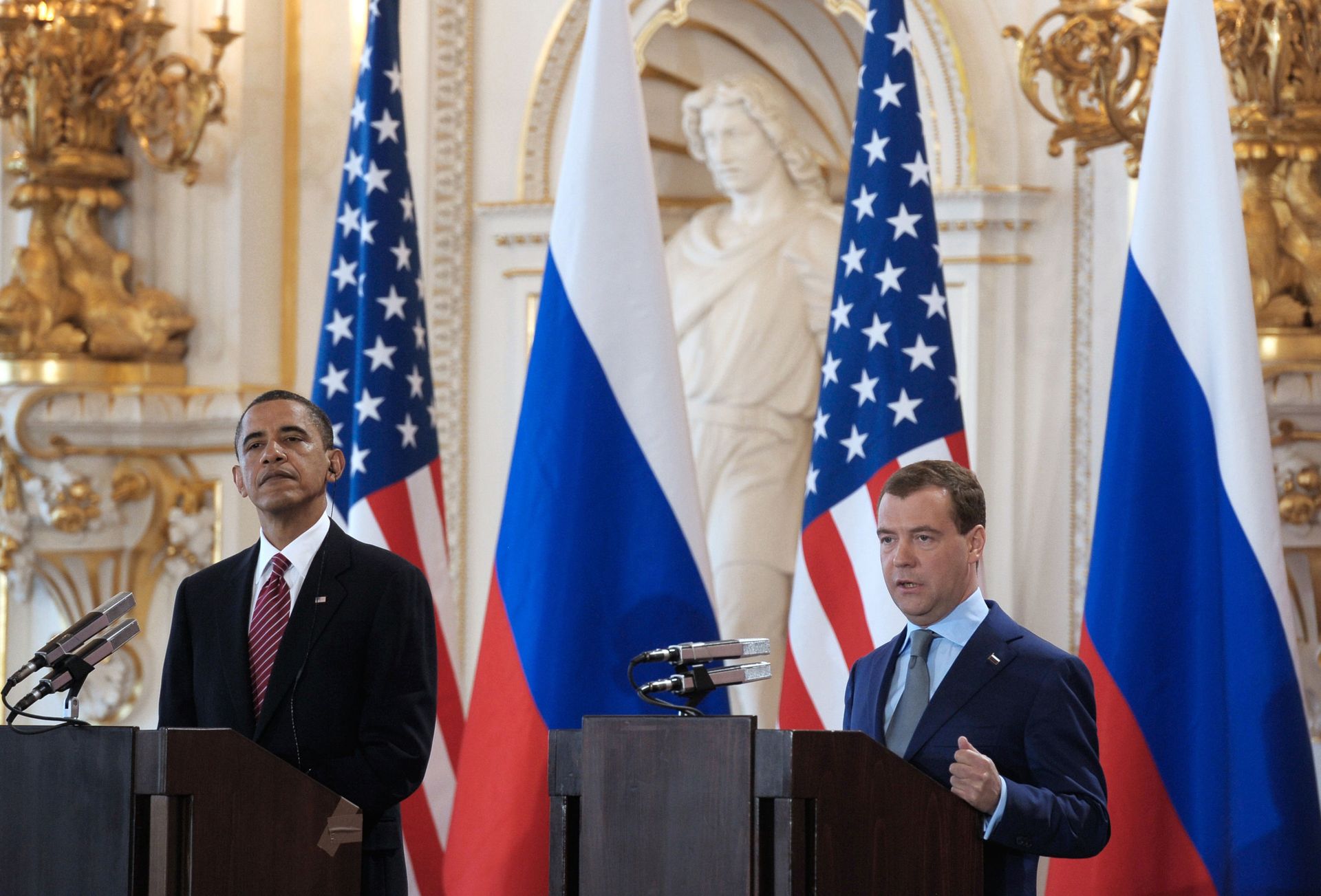
Leading expert on Russian-American relations Thomas Graham, a former advisor to the previous U.S. administration, comments on the chances for ratification of the new START Treaty signed by Presidents Dmitry Medvedev and Barack Obama. The Treaty is to be ratified by the Russian Parliament and the U.S. Senate.
Mr. Graham is a senior director at the consulting firm Kissinger Associates in New York. He shared his views on the issue in an interview with RIA Novosti New York Bureau Chief Dmitry Gornostaev.
- Mr. Graham, soon after the signing of the new START Treaty, American diplomats indicated that the process of its ratification may stretch over to the next year. Do you share this point? Why do administration officials talk about such a relatively long period although key Republican Senator Richard Lugar has already welcomed the treaty?
- I do not believe that this treaty will be ratified quickly, although I do believe it will be eventually ratified. Two complex and controversial issues will dominate the debate: the future of the American nuclear arsenal and the Obama administration's Russia policy. On the first issues, Republicans will want to press the administration to commit to modernizing the nuclear forces, even as its size is being reduced, and they will seek assurances that the administration is still committed to missile defense. On the second, the Republicans will raise questions about the direction of the administration's policy, particularly if there is a sense that Russia is not being as helpful as it could be on Iran. Both these issues need to be debated fully before the treaty is ratified. Finally, the Republicans will want to put off the ratification of the treaty until after the mid-term elections in the hopes that those elections will increase their leverage vis-a-vis the White House.
- What are the main arguments to the critical aspects of this treaty in the Senate? Can the ratification be affected by domestic issues debated on the Hill?
- The main arguments are that the treaty limits the United States' ability to build an effective missile defense system and that the United States has conceded more than Russia, in part because Russia, in their view, has no option but to draw down its nuclear forces, while the United States can easily maintain its nuclear forces at current levels. Domestic issues are unlikely to affect the ratification of the new START.
- Don't you think that the White House and the Kremlin overestimate this treaty as a means of pressure on those whom they want to abandon nuclear ambitions - Iran and North Korea? The Iranian president has apparently downplayed the role of this START agreement in his speech at the NPT Conference. Many other countries, too, are saying that these cuts by the leading nuclear powers are far from being enough. What is your evaluation of this Treaty as an impetus to the process of global disarmament and non-proliferation?
- The treaty is evidence that the United States and Russia are honoring their obligation under the NPT to reduce their nuclear arsenals. That is a positive step in and of itself, but it will do little to increase pressure on Iran or North Korea to abandon their nuclear ambitions, nor will it keep some other nuclear powers from continuing to build up their arsenals. The reasons countries pursue nuclear weapons or build up their arsenals in general has little to do with the exact size of the American or Russian nuclear forces. Pakistan and India, for example, are concerned about one another. North Korea believes that even a small number of nuclear weapons enhances its security.
- Is it possible that the U.S. can persuade Israel to agree on creating in the future a nuclear-free zone in the Middle East?
- The short answer is no. Nor will the United States pressure Israel to agree to a future nuclear-free zone in the Middle East any time soon, if ever.
- Why?
- The United States is already pressuring Israel on settlements and other matters to push forward the peace process. Adding pressure on a nuclear-free zone would only unnecessarily complicate matters further - particularly when Israel believes it faces an existential threat from Iran - and the result would likely be no movement on the peace process and no movement on a nuclear-free zone.
- Do you think that the current NPT Conference can repeat the destiny of the 2005 Conference and fail without adopting a declaration if Western countries don't reach a compromise with the Arabs on the text of the final document and, in particular, on a nuclear-free Middle East?
- The 2005 Conference ended without a document because of a fundamental disagreement between Russia and the United States. This will not likely occur during the present conference. Absent a fundamental disagreement between the United States, Russia, and the other nuclear powers, it is almost certain that compromise language will be found to ensure that the Arabs - and all other countries - agree to the final document.
- What further steps on disarmament can Russia and the United States undertake? Some American experts talk about possible reductions in non-strategic weapons and non-deployed nuclear warheads. Is this an option or could there be other steps?
- All these are options. The United States and Russia do not necessarily need an agreement to reduce non-deployed nuclear warheads; each could do that unilaterally. But an agreement is almost certainly necessary to reduce tactical nuclear weapons. Russia, however, does not appear to be interested in reducing such weapons at this point, particularly given continuing concerns about the capabilities of its conventional forces.
- Will the issue of the U.S. missile defense emerge again, maybe as an irritant, at the Russian-American talks or is this closed, at least for several years after being mentioned in the preamble of the new START Treaty?
- Russia has made it clear that the US missile defense program remains a concern and it will monitor the US program very closely despite the language in the new treaty. If negotiations commence on further reductions, Russia will almost certainly want to put in language in any new treaty that would further limit US options on missile defense.
- How would you comment on Ahmadinejad's claim that Iran is ready for a nuclear fuel swap? Iran's ambiguity on this matter became one of the reasons for the U.S. push for sanctions. Is there still room for giving credit to Tehran on this issue, in particular, and on Iran’s nuclear program in a broader sense?
- The United States, Russia, and others offered Iran a deal last fall. If Iran were to accept it unambiguously and without condition, it could sidetrack the push for sanctions. But that is not where Iran is today, and Ahmadinejad gave no indication that he is ready to accept that deal.
- Why do you think the negotiations on the fourth round of sanctions against Iran are taking so much time? The White House has been calling for them since the end of the last year. Is there a possibility of eventual dissolution of the idea of sanctions, especially now, when Brazil and Turkey emerged as new negotiators with Iran, and Tehran itself has intensified its diplomatic activities engaging with other members of the Security Council?
- The United States, Russia, and China have different interests in Iran and varying assessments of the threat Iran's nuclear program poses to them and more generally to the international system. These differences are reflected in the way these countries approach the issue of sanctions. That was the reason it took considerable time and effort to negotiate the first three rounds of sanctions; there was no reason to believe that it would prove different with this round. The positions of Turkey and Brazil only complicate the matter further. That said, the United States will continue to push for sanctions, along with its European allies, and I would suspect that a sanctions resolution of some sort will eventually be adopted by the UN Security Council. The question is the exact nature of the sanctions and, more important, whether they will have any impact on Iran's behavior. In my view, any sanctions the UN Security Council is likely to pass will not deter Iran from continuing its pursuit of nuclear weapons.
- On the Russian-American "reset," what can be done further after the START treaty is signed? Will anything else be a part of the reset or it's doomed to limit itself only by arms reduction and fighting terrorism? Can we expect any other major breakthrough comparable to the START treaty in other areas?
- The administration has just resubmitted the 123 agreement on civil nuclear cooperation with Russia to the Congress. If that agreement passes the Congress, it will provide an opportunity for much mutually beneficial cooperation in this area, including, for example, a joint US-Russian venture to build peaceful nuclear reactors in third countries. That would mark another breakthrough in US-Russian relations.
NEW YORK, May 13 (RIA Novosti)