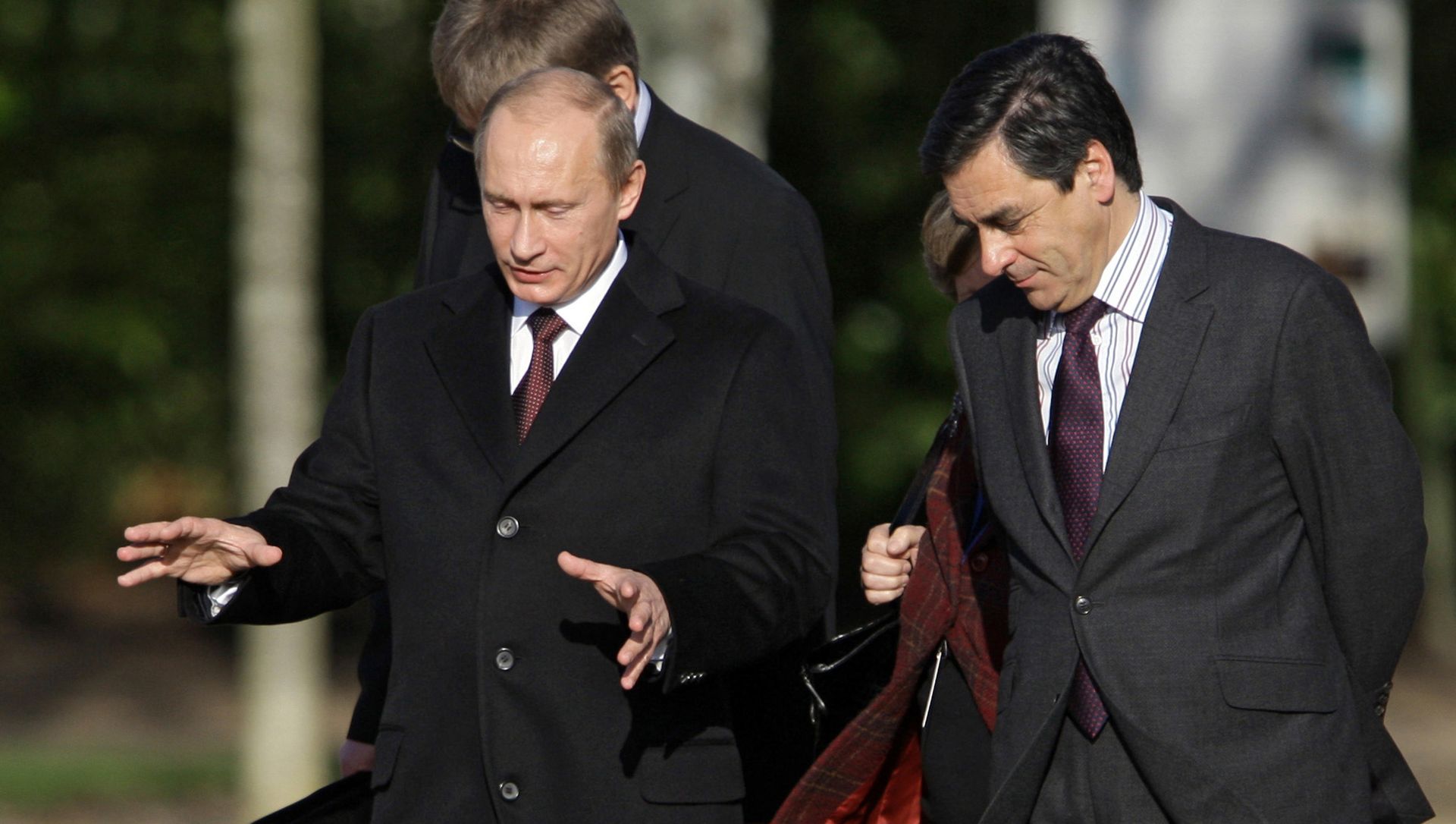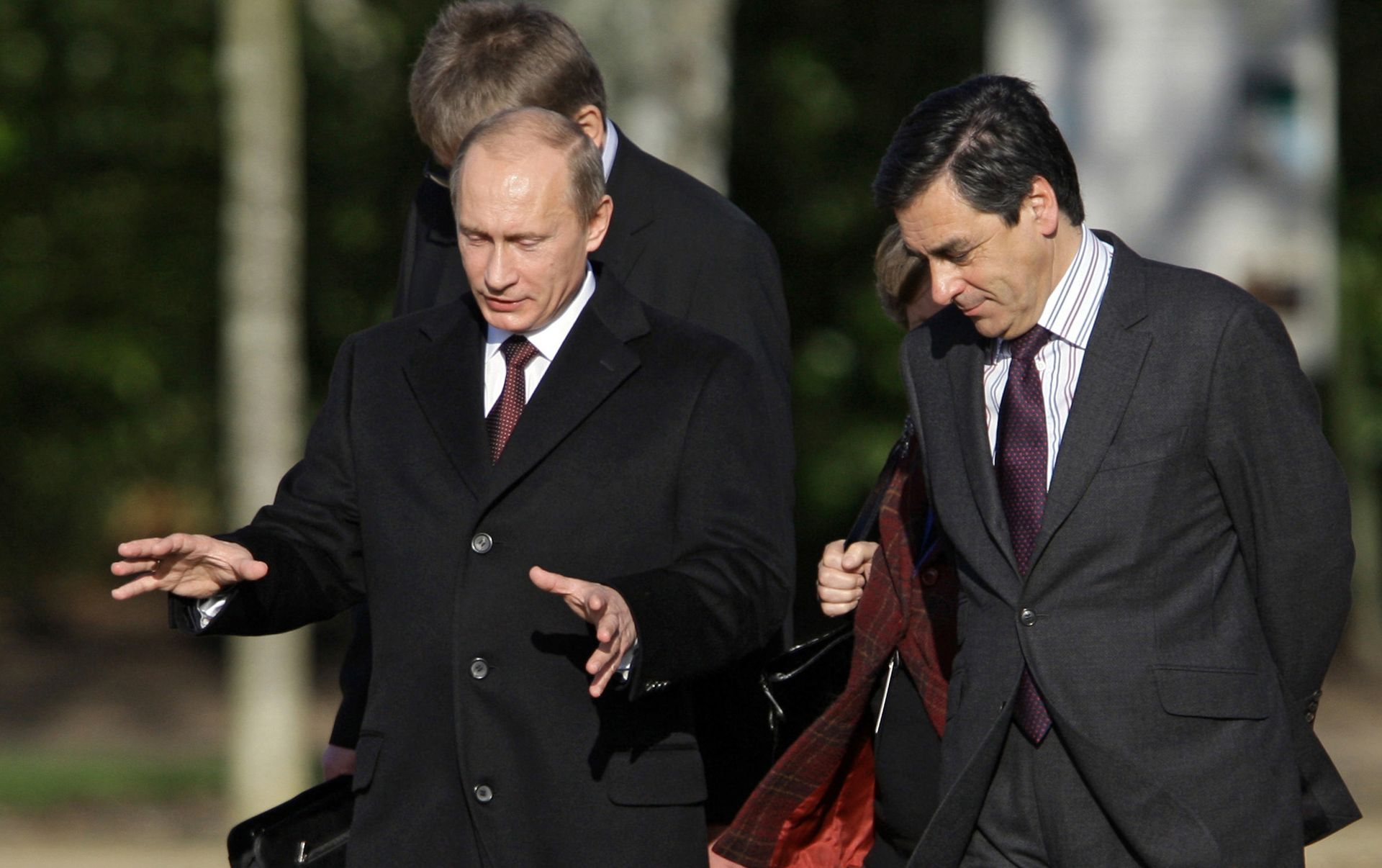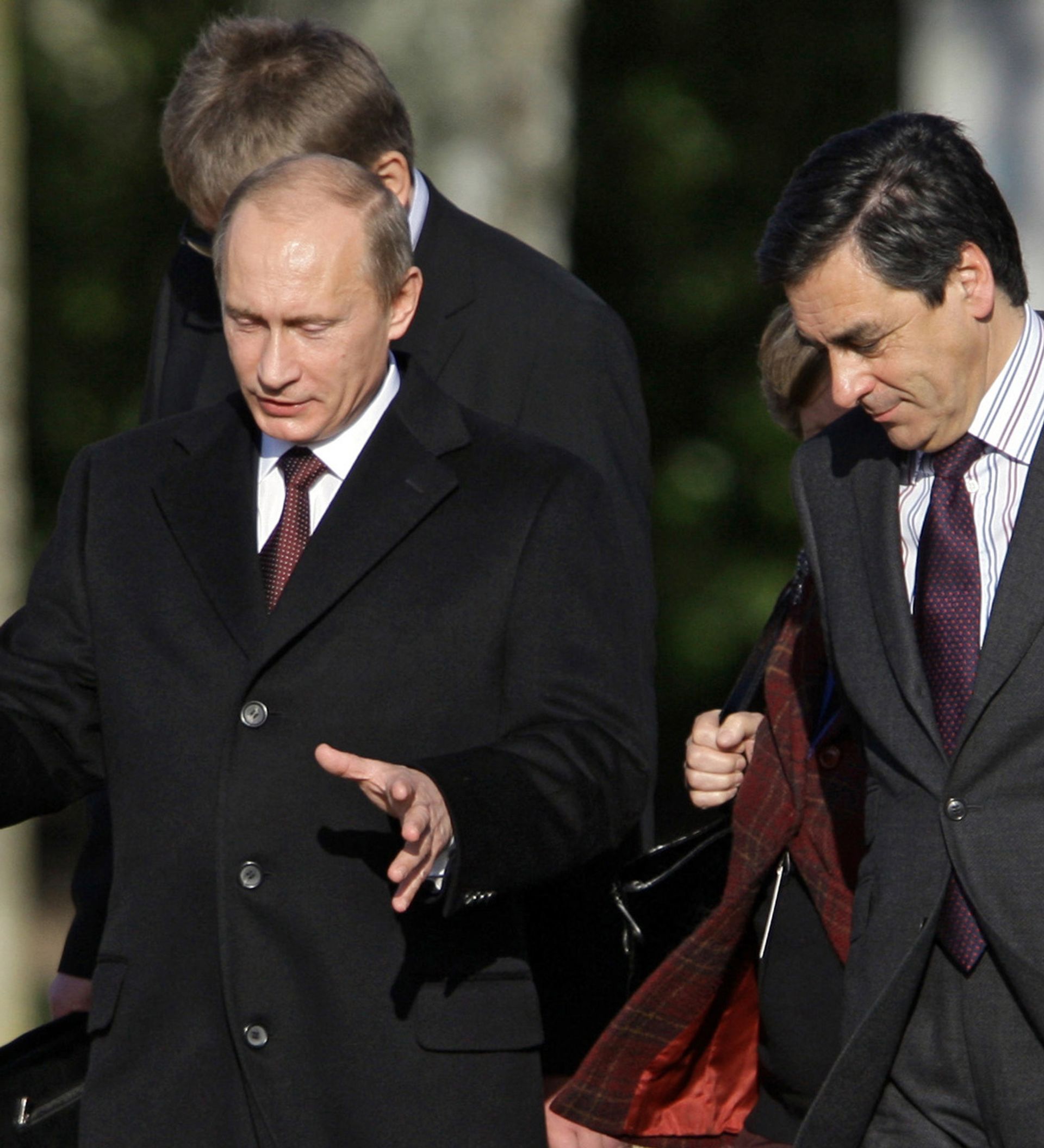
This week's visit to Moscow by French Prime Minister Francois Fillon could have been described as totally positive if not for the blizzard that Mr. Fillon brought with him from Europe. He was among the blizzard's victims, as his delayed flight from Paris Wednesday prevented him from attending a gala at the Bolshoi Theater to mark the end of the Franco-Russian cultural festival that had been running in both countries throughout the year. But Vladimir Putin made up for it by taking his French counterpart to a supper in a bohemian Moscow restaurant, frequented by members of the local literary elite.
Fillon's two-day sojourn continued into Thursday with a meeting with President Dmitry Medvedev. Ahead of the visit, Medvedev spoke on the phone with his French counterpart, Nicolas Sarkozy.
During such year-end conversations, world leaders usually plan on some high-profile events to wind down the season in spectacular fashion and also discuss which bilateral issues can be put on the backburner for the time being.
Moscow spent the week in suspense, speculating about whether, during Fillon's stay, Russian officials would confirm their intention to buy Mistral helicopter carriers from France or reiterate their determination to go ahead with a Moscow-St. Petersburg highway project despite protests by environmentalists and the general public.
But contrary to expectations, Fillon's visit proved quite low-key, and no momentous decisions were announced. The Mistral deal is not yet in the offing, apparently because Sarkozy considers it too important to be delegated to his premier. And no final decision has yet been made with regard to the controversial highway, which would run through the Khimki forest, outside Moscow.
Russia asks France for master class in energy conservation
The outgoing year has been an especially eventful in terms of Russian-French culture exchange, and its many artistic happenings overshadowed the flurry of economic, financial, industrial, and scientific cooperation between the two countries. This became apparent at the 15th session of the Russian-French intergovernmental commission for trade, economic, scientific and technological cooperation, which took place during Fillon's latest visit and was co-chaired by him and Prime Minister Putin.
Fillon came with a delegation of business executives representing more than twenty leading French companies involved in energy, industrial production, banking and trade. The figure does not look particularly impressive, though, if we recall that as many as 6,000 French businesses are now working with Russian partners.
Among the many deals struck by the two nations, there are two that stand out: an agreement to establish a center for energy-saving technology and an accord on partnership in economic modernization.
Russia has been able to get away with using energy inefficiently for years thanks to its abundant and cheap natural resources, such as timber, coal, oil, gas and water. But the situation is about to change.
Already, it cost twice as much for Russia to generate its GDP as the world's average in terms of kilowatts per hour. Thus, the production of one dollar's worth of industrial output takes 1.8 kWh in Russia, as compared with 0.9 kWh elsewhere in the world. The amount of energy consumed by Russia's industrial enterprises is three times as much as in Western Europe, 2.5 times as much as in the United States, and twice as much as in China. So, turning to the French for counsel in energy-saving technology may prove an appropriate and timely move.
We could also ask Japan to share its expertise with us, as that country has a remarkably low energy consumption rate, just one-sixth of Russia's. But the unresolved dispute over the Kuril Islands, referred to by Japan as the Northern Territories, complicates matters.
Russia has been trying to reduce its industrial energy consumption since 2000, when it ranked 135th on world ratings. By 2008, it brought its rate down 35%, and was able to rise to 120 on the list.
Russia's extravagant energy consumption has until now been compensated for by the relative cheapness of its resources. But for how much longer will the Russians enjoy the benefit of cheap energy? Clearly, that advantage will be taken away from them following the country's accession to the World Trade Organization, which now looks imminent. This is why President Medvedev has indentified energy efficiency as a key priority of his ambitious modernization plan.
Tales of the Khimki Forest
The Moscow-St. Petersburg highway controversy is not a strictly Russian affair. France has something at stake here, too. The French infrastructure construction firm, Vinci Construction, is a subcontractor for the project's first leg, which involves a path being cleared through the Khimki forest.
The project was put on hold this past summer, after Russian environmentalists and members of the public held a series of rallies to protest the planned destruction and demanded that the road be rerouted. President Medvedev responded by promising to revisit the initial plan. But ahead of Fillon's visit, he allegedly decided to back down on that promise and return to the original design. This decision was explained by the high compensation costs the Russian authorities will incur if they drag their feet on the project. Violating the terms of the contract with Vinci Construction could cost Russia as much as 85 million euros in damages.
East meets West through culture
As for this year's cultural exchange between the two nations, it has been free of controversy, and carried out on an unprecedented scale.
The Comedie Francaise's Russian tour, which spanned this country from west to east, was, undoubtedly, one of the main highlights. France's oldest and best-known theatrical company, founded back in 1680, performed in Moscow, St. Petersburg, Kaliningrad, Yekaterinburg, Omsk and Novosibirsk, staging a production of Pierre Beaumarchais' "The Marriage of Figaro."
A large-scale exhibition at Moscow's Pushkin Fine Arts Museum featured works by Pablo Picasso on loan from Parisian museums, as well as paintings by Degas, Renoir, van Gogh, Toulouse-Lautrec, Modigliani, Matisse, and Chagall. In March, 450 examples of early Russian art traveled to Paris to be displayed at the Louvre. Two shows devoted to Napoleon Bonaparte opened in Moscow in September, at the Tretyakov Gallery and the History Museum. These exhibits featured both portraits and memorabilia.
During the year-long cultural festival, Russia and France decided to set up a movie academy to support collaborative film projects and to establish an international school for fiction translators in the city of Arles in the south of France.
After Paris was nearly brought to a standstill by heavy snowfall earlier this week, it would be natural for the French delegation to examine how Moscow authorities usually cope with the high levels of precipitation in wintertime. But Minister of the Interior Brice Hortefeux said it is unlikely Russia's expertise will come in handy any time soon, as the climate of the central Ile-de-France region is much milder in comparison with Moscow or northern Canada.
However, Fillon promised Prime Minister Putin that France will share its expertise hosting the World Cup with Russia, which was recently selected to host the tournament in 2018.
The views expressed in this article are the author's and do not necessarily represent those of RIA Novosti.