Sputnik has discussed this with John Curtice, professor of politics at Strathclyde University.
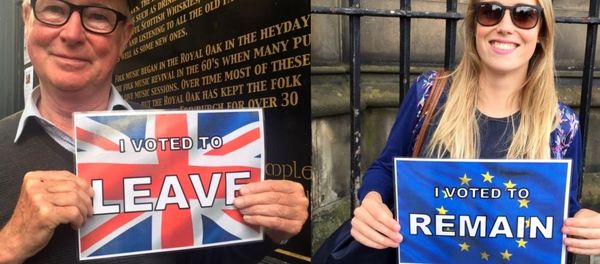
Sputnik: What do you make of calls for a second referendum? How democratic is it to contest the will of Britons who have already voted to leave?
John Curtice: The calls for second referendum have been gathering pace for quite a while and there is now indeed an organization called the People’s Vote which has been formally campaigning for this idea. What of course is true, however, is that the Chequers Agreement — the proposals that the UK government published at the beginning of this month for what it wants in the way of a future relationship between the UK and the EU – has shall we say, disappointed Leave supporters who think it’s too soft, but also done very little to accommodate the views of Remain voters, or at least that’s what the Remain voters themselves think. And as a result, therefore, the Chequers Agreement is very unpopular within the public.
It’s not supported by the Leave or Remain voters. So I think this has certainly added another ratchet to the campaign for having a second referendum.
READ MORE: Breaking Up is Hard to Do: Over 300,000 Britons Demand 2nd Brexit Referendum
Truth is, whether not we’re going to get a second referendum probably doesn't depend for the most part on public opinion, or at least only indirectly.
What it is going to depend on is whether or not:
A. The UK government can get a deal with the European Union, can it come to any kind of agreement at all;
B. If it does, whether it can get that agreement through the House of Commons, and the truth is, that it’s not clear that the UK government can either get no deal through the House of Commons or any deal that certainly looks like the Chequers Agreement would also command a majority in the House of Commons.
In other words, there’s a serious risk that the UK government, even if it succeeds in negotiating with the European Union, will not be able to get backing for that stance in the House of Commons.
That will then raise the question: so what next? And in the wake of such an outcome the current UK government would probably fall and then the question is: what next? Maybe we can get another government that’s sustained by the House of Commons, but that doesn’t look terribly likely.
Therefore, how do we resolve the issue? Well, one of the answers is to have another general election to get another government, but it’s not entirely clear whether that will solve the issue, or do we have another referendum on the terms of the deal, and in effect allow the public to decide whether or not the deal is good enough rather than leaving it to the House of Parliament, which probably is incapable of having a majority, frankly, in favor of any solution to Brexit.
John Curtice: Well, it certainly underlines how difficult the path that the UK government is trying to tread. It has, finally, after 18 months, internally managed to reach an agreement about what it wants, but that’s an agreement which, despite the best endeavors of the UK government to set a precedent in the White Paper, is clearly looking for a different relationship between the UK and the EU; that is currently available to any so-called third country, a country that's no longer a member of the European Union.
Certainly, central to the UK government's stance both in terms of being able to get frictionless trade and also trying to deal with the issue of the Northen Ireland border, was this idea that we were to basically have a customs union on goods but we would not call it that and we would collect the EU's tariffs, and not surprisingly, the immediate reaction of the European Union is — hang on, we’re really not sure that that's something we’re happy to accommodate.
READ MORE: EU, UK Agree on 80% of Brexit Deal, Including Citizens' Rights — Negotiator
That’s why, of course, Theresa May has been to Salzburg to talk to the Austrian chancellor and the Czech prime minister, and that’s why other British ministers are going to be claiming some air miles through the course of this summer going to EU capitals. Because what they’re trying to do is, they're now trying to say to the individual governments — look, you need to re-examine the negotiating instructions you’ve given to Michel Barnier because otherwise there is a risk that we won’t get a deal.
And the UK government is hoping that having come up with something that they think actually might be at least of some interest to the European Union in terms of reducing the economic costs of Brexit for the EU, as well as for the UK, means the EU, therefore, as a result, is willing to re-think their position.
The truth is, so far at least, the European Union has shown very little interest in doing something that doesn’t accord to the current rules and procedures of the European Union, and the task that the UK government has is whether or not it can change that mindset or not. The European Union is not saying this is all hopeless, and some of it, clearly, the European Union likes, particularly, the stuff on security, but on the central issue of the customs arrangements and the single market the two sides are clearly still quite well apart.
John Curtice: I’m not quite sure who’s trying to scare who with this. I suspect in part it’s the UK trying to say to the European Union that we are willing to prepare for this if we have to, to try to strengthen the negotiating position, but the bottom line is, it’s relatively straightforward.
If we crash out of the European Union without a deal, then on the 30th of March next year, in theory, there should be customs posts at Dover, at Calais etc. We should be ready to collect tariffs, we should be ready to collect duties, inspect goods etc., and, of course, neither on the EU side of the English Channel, nor on the British side, nor indeed on either side of the Irish border is anybody ready for any of this.
READ MORE: 'Very Mythical': Netizens Ridicule Brexit White Paper Translation Fiasco
Everybody is still operating on the assumption that they have at least till December 2020 to sort out what arrangements need to be in place, but we're now 7-8 months away of getting out of the European Union and nobody’s in the position to be able to have necessary positions in place.
Therefore, clearly there must be a risk that food and medicines, and lots of other things are going to struggle to get across the border until some emergency arrangements are put in place. That is, if indeed, we end up in a situation where there is absolutely no deal at all and we just simply leave and walk out the door of the European Union.
The views expressed in this article are those of the speaker, and do not necessarily reflect those of Sputnik.