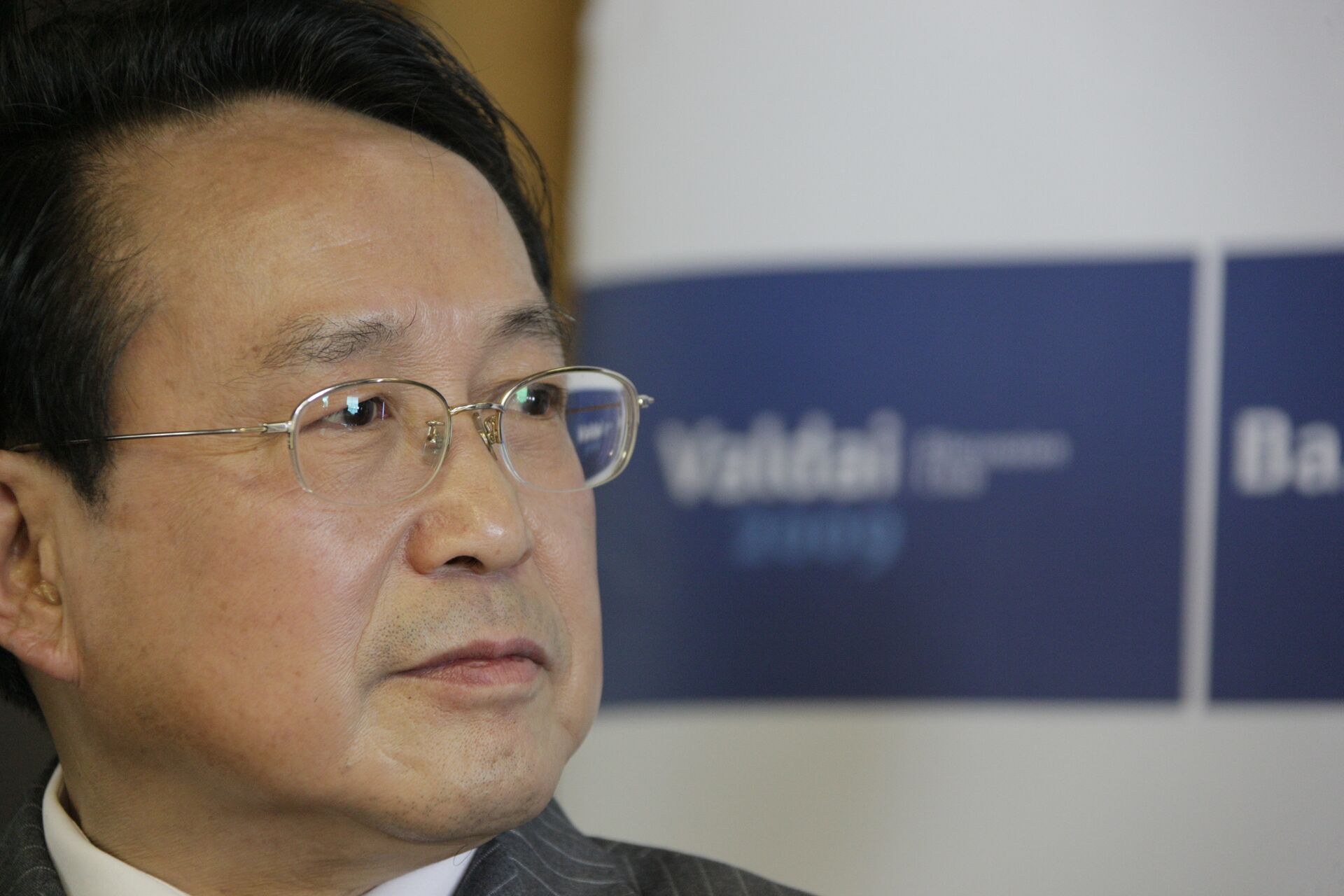
Sheng Shiliyang
Chief Researcher with the Center for Global Challenges Studies, Xinhua News Agency; Chief Researcher at the Institute for Social Development of Eurasia (the Center for Development Research under the State Council of the People's Republic of China)
Ancient Chinese philosopher Confucius (551 B. C. – 479 B. C.) taught that the He concept of peace, accord, harmony, kindness and unification was the most precious aspect.
“No great loss without some small gain,” as the Russian saying goes.
Instead of dividing the international community, new challenges facing humankind will unite it.
1) It is only through joint efforts that we will manage to build a new economy in our global world.
Expanded production volumes in the United States, Europe and Asia show that the global economy is recovering much faster than the analysts had predicted.
At first glance, the Chinese student has passed the anti-crisis test, posting 7-8% GDP growth.
China has invested over $700 billion in the U.S. state debt, has become its main creditor and relies heavily on America.
Our economy will not post substantial growth if the global economy does not become more confident, and if the United States, the European Union and Russia do not buy more Chinese goods.
2) A new reserve currency will comprise several powerful global currencies.
It is already clear that the Chinese yuan, which has not yet become a new reserve currency and which isn’t even a convertible hard currency, will not play this role. China has a weak voice on the global currency market. The global reserve currency must reflect the current line-up of forces inside the global economy. A currency basket comprising the U.S. dollar, the euro, the British pound, the Russian ruble, the Japanese yen and the Chinese yuan is a more or less acceptable option.
3) There will be several international players, most of whom are already part of the G20 major economies.
Some ambitious Chinese academics believe that China, which has nearly $2 trillion in currency reserves, can dictate its terms to the global financial market.
This concept is absurd.
First of all, we have more than enough domestic problems. Although official statistics estimate the number of unemployed at 12 million, China now has somewhere between 24 million and 33 million jobless persons or part-time workers.
True, the state invests $600-700 billion in the program to stimulate the economy, develop infrastructure and boost consumer demand. But this is fraught with snowballing bad debts for the economy and the reinstatement of energy-intensive and toxic production facilities. Bank payables increased throughout January-June 2009, exceeding the sum total of 2008 loans. Instead of facilitating innovation, this process serves to reinstate backward production facilities.
Consumer demand is unlikely to grow because many people, primarily farmers and people with low incomes, lack access to adequate healthcare and pension programs and have to save money for a rainy day and their children’s education, rather than for buying new cars.
Is our financial organism ready to do without vitamin injections? We are so far unable to answer this question.
Moreover, China has an enormous population. If you divide any of its huge financial or material resources by the number of people it has, you will still receive meager sums. And if you multiply any mishap by the same 1.3 billion, you will get a big problem.
Second, in China, just like in Russia, the economy is substantially dependant on external factors. Foreign academics wishing to get acquainted with China should first visit poor rural regions or the Gobi Desert in north-western China, rather than the luxurious Shanghai riverside or the fashionable Wangfujing district in Beijing.
Fourth, our elite has an extremely unpleasant mentality. Once Chinese people get rich, they buy Mercedes-Benz 600 limousines, while their Indian counterparts prefer small Tata Nano cars.
4) Global climate change and warming.
It’s high time we start overhauling our economic development model and lifestyle.
Vladimir Putin was right for criticizing one specific power for excessive consumption of wealth and another power for its excessive production of goods and the issuing of excessive consumer loans to the former.
Why does China manufacture so many goods it is unable to consume?
Does China have to buy expensive fuel and energy, metals and wood and sell its ready-made products cheaply?
Must we pollute China’s environment and face criticism for polluting the global environment? Must we face anti-dumping procedures? And must we forever remain the unskilled laborers of the global economy?
No, it is impossible to live like this anymore.
Here is what we must do:
First, we have already managed to turn China from a global village into a global workshop. Now we must turn China from a global workshop into a global market, a consumer market, and a hi-tech and services market. In 1978, the services sector accounted for 23.9% of the Chinese GDP, reaching 40.1% in 2007. Considering our tremendous workforce reserves, the service sector should account for at least 55% of the Chinese GDP at a time when the respective U.S. share is about 80%.
Second, we must start reducing pollution levels. Since June 2008, Chinese authorities have banned the issue of free plastic bags at supermarkets, cutting their consumption by 40 billion units, saving three million metric tons of oil and reducing carbon-dioxide emissions by nine million metric tons.
Third, we must reduce per-capita GDP energy intensity. In the past three years, the respective Chinese indice has fallen by 10.1%.
Fourth, we must consume more energy from renewable sources. For instance, China will install wind driven power plants generating 100,000 mWt of electricity and will reduce solar battery production costs to 70 cents per watt, so that solar energy could compete against traditional fuels.
Fifth, we must invigorate international cooperation. Indicatively, our Western friends have suddenly turned from champions of democracy and human rights into ardent environmentalists. It’s very good, indeed. But it does seem unfair when the U.S. Congress does not approve greenhouse emission quotas, which are 3-4 times lower than the relevant Chinese quotas. It would be better to assist China in acquiring energy-saving technologies, rather than to be the Great Teacher of the Chinese People in the field of environmental protection.
Coping with new challenges through joint efforts
© RIA Novosti
Subscribe
China has invested over $700 billion in the U.S. state debt, has become its main creditor and relies heavily on America. (By Sheng Shiliyang, Chief Researcher with the Center for Global Challenges Studies, Xinhua News Agency)