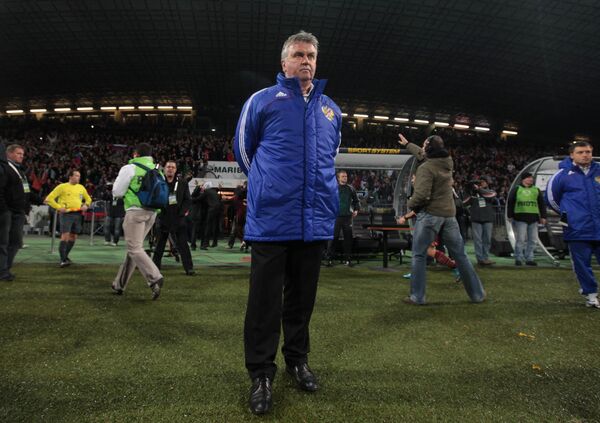
MOSCOW, November 20 (Marc Bennetts for RIA Novosti) - Guus Hiddink has often been described in Russia as a football magician for his success in turning around the fortunes of the national side, but his magic lost its power on Wednesday evening.
Russia's catastrophic defeat to Slovenia in a World Cup play-off came just days after the Mult Lichnosti satirical animated show on state-run TV had portrayed the portly coach as a wizard casting spells over a bubbling cauldron to ensure Russia's continued success.
"Let Akinfeev catch everything that flies, let our opponents fear us..." Hiddink, wearing a floppy wizard's hat, muttered in the Channel One cartoon.
Hiddink had undoubtedly earned his miracle-man reputation, transforming a demoralized and oft-mocked Russian team into Euro 2008 semifinalists in just two years. But, as his "Lucky Guus" nickname suggested, fortune also had a large part to play.
As England fans will recall all too well, had Steve McClaren's side not gone down 3-2 at home to Croatia in the last Euro 2008 qualifier, Russia would not even have made the finals. Had Scott Carson not suffered one of the worst goalkeeping debuts in the history of international football, Andrei Arshavin would have spent the summer sunbathing rather than running rings around Sweden and Holland's defenses.
Hiddink, who is paid around $9 million per year to coach the Russian team, has yet to confirm that he will take up an offer to lead the team's Euro 2012 challenge once his current contract expires next July, and the defeat to Slovenia has led to calls for him to quit.
The 63-year-old trainer has been criticized for spending too much out of Russia and starting both games against Slovenia with Roman Pavlyuchenko, who has not played a full 90 minutes in the Premier League for Tottenham Hotspur this season.
"Hiddink's mistakes in team selection are obvious," former U.S.S.R. forward Viktor Ponedelnik commented in an interview with Sport Express. "For the colossal sums of money that he is paid, he should spend more time in Russia."
"He should hand in his resignation," the Soviet striker went on.
Hiddink's decision not to even call up Rubin Kazan forward Alexander Bukharov, with 16 goals in the Russian Premier League this season, left many in Russia bewildered, especially given the inclusion of Alexander Kerzhakov, who has scored twice for Dynamo Moscow since August.
Did Hiddink start to believe his own press? Did he buy into the myth of infallibility built up around him? Or was everything down to the much simpler issue of the language barrier? Despite coaching Russia for over three years, polyglot Hiddink's Russian remains extremely basic.
"Hiddink's main problem is that he doesn't speak Russian," former under-21 coach Boris Stuklalov told Sovetski Sport. "That's why he can't fire the team up for real. As a result, our guys went out onto the pitch unprepared."
There have even been those who have questioned Hiddink's "Lucky Guus" tag.
"I have to admit, I never had much faith in Hiddink," actor and football fan Mikhail Boyarsky told the rusfootball.ru website. "Everyone always yelled 'Lucky Guus!' But he's not lucky at all."
"I reckon his time in Russia is over - it's probably not that interesting for him to work with us. But I can't deny - Guus did a lot for our game, and a low bow to him for that!"
So if Hiddink's time in Russia is up, who will replace him?
Dynamo Kiev coach Valery Gazzayev has been touted as the man to take control, but the former CSKA trainer has already tried his hand with the national side, walking out in disgust after a home friendly defeat to Israel in 2003.
A much more interesting choice would be Rubin Kazan coach Kurban Berdyev, who has taken his side to the brink of successive domestic titles and recently engineered a famous victory over Barcelona at the Nou Camp.
But the only hitch with Berdyev, if he could be persuaded to take the job, would be a non-football issue. The Turkmenistan-born trainer is a devout Muslim, and routinely intones "glory to Allah!" after Rubin victories. Vladimir Putin may have declared that "Russia is, to some extent, part of the Muslim world," but are his countrymen fans really ready for a Muslim coach?
Of course, Hiddink could stay on for a while to come. He may even lead Russia to Euro glory in Ukraine and Poland in 2012. But for now, the magic has worn off and the luck has run out.
The opinions expressed in this article are the author's and do not necessarily represent those of RIA Novosti.
Marc Bennetts is the author of Football Dynamo: Modern Russia and the People's Game (Virgin Books)
M.bennetts@rian.ru




