Every year, the Russian judicial system hands down a number of unexpected rulings and dramatic judgments on interesting issues and cases, and 2009 was no exception. The death penalty was de facto abolished and individuals involved in several high-profile cases were released from prison, one of the country’s senior investigators was indicted, the investigation into the murder of journalist Anna Politkovskaya was halted and a second case against former Yukos heads Mikhail Khodorkovsky and Platon Lebedev was opened.
The death penalty resolution
On November 20, the Russian Federation’s Constitutional Court finally abolished the death penalty in Russia. The court explained that Russia is bound by international agreements prohibiting this exceptional measure of punishment; therefore, even if jury courts start operating in all regions on January 1, 2010, this will not allow the reinstatement of the death penalty.
Surveys show that 41% of Russians are in favor of reinstating the death penalty and another 12% support reinstating it and expanding its application. A number of public figures and government officials spoke out in favor of reinstating the death penalty from January 1. Experts linked Russia’s resolution of the death penalty issue with the country’s choice of direction for its long-term development.
Repeat tax inspections are rescinded
On March 17, the Constitutional Court prohibited tax authorities from carrying out repeat inspections of taxpayers where a court ruling on the results of a previous inspection is in force. Consequently, the Constitutional Court declared Paragraph 10, Article 89 of the Tax code, which allowed repeat inspections, to be unconstitutional.
The Constitutional Court had already specified that repeat tax inspections must be carried out only where necessary, that they must be justified and lawful, thus ensuring they are not used to suppress economic independence or limit the freedom to conduct business and exert property rights. The legal problem that the Constitutional Court resolved consisted of whether the tax authorities could adopt a different resolution from that already confirmed by the court.
Khodorkovsky and Lebedev: Part 2
The trial in the second criminal case involving the former heads of Yukos and Menatep, Mikhail Khodorkovsky and Platon Lebedev, started in spring 2009 in Moscow’s Hamovnichesky Court. Khodorkovsky and Lebedev had already been sentenced in 2005 under seven articles of the Russian Federation Criminal Code to eight years in prison. This time, the two ex-businessmen were accused of embezzling securities belonging to the state, and of the theft of 350 metric tons of oil.
The court is currently hearing evidence related to the charges and a sentence is expected no earlier than spring 2010. And exactly one week before the New Year, the Presidium of the Supreme Court of the Russian Federation handed down a ruling, the legal consequences of which cannot be foreseen: that Lebedev was arrested illegally in the first criminal case. This ruling was made following the response from the European Court of Human Rights to one of the petitions filed by Lebedev, which Khodorkovsky also filed.
The ruling is unprecedented in Russian legal practice.
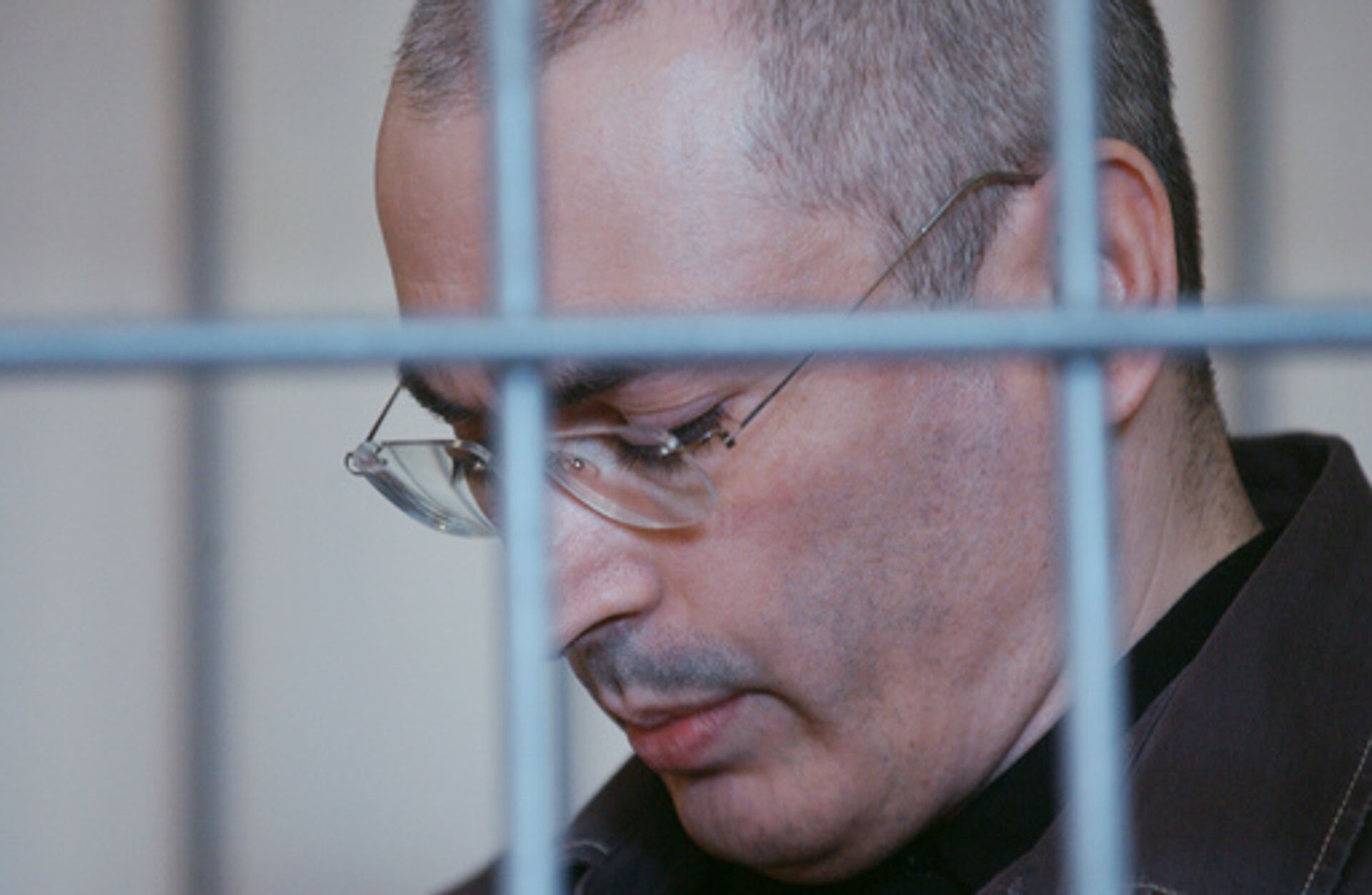
Mikhail Khodorkovsky in Moscow’s Khamovniki District Court
The Politkovskaya affair: court case, acquittal, supplementary examination
In February 2009, the Moscow District Military Court (MOVS) handed down a verdict of “not guilty” in the sensational case of the murder of Novaya Gazeta correspondent Anna Politkovskaya, and in September, on a directive from the Supreme Court, MOVS returned materials to investigators. Now the investigators intend to merge the case of Ibragim and Dzhabrail Makhmudov and Sergei Khadzhikurbanov with that of the alleged hitman Rustam Makhmudov and “other unidentified persons.”
Public interest in the Politkovskaya affair is linked to her tireless journalistic activity and the position she took on many issues. Interest in the trial was also spurred on by the presence among the accused of ethnic Chechens and former employees of the Russian secret services: in the light of the fact that Politkovskaya investigated human rights violations in the North Caucasus.
The condemned investigator
Investigator Dmitry Dovgy, who was investigating the Yukos and Khodorkovsky cases, has himself been imprisoned.
On the basis of a jury verdict in June 2009, the Moscow City Court found Dmitry Dovgy, the former head of the Main Investigative Directorate of the Investigative Committee at the Russian Federation Public Prosecutor’s Office, guilty of accepting a 750,000-euro bribe and abusing his authority.
Now the former investigator faces nine years in a maximum security prison if, of course, the Russian Supreme Court does not hand down a different ruling on Dovgy’s petition in the trial, which has been postponed until mid-January.
It was intriguing that Dovgy’s crimes were uncovered right after he gave an interview to State Duma Deputy Alexander Khinstein for the newspaper Moskovsky Komsomolets, in which he said that in his opinion, Investigative Committee employees are engaged in the unlawful persecution of certain citizens. Dovgy gave the interview as a former employee of the agency and he was detained one day prior to the Moscow City Court hearing on his reinstatement claim. Two days later, Moscow’s Basmanny Court authorized his arrest. The Moscow City Court denied Dovgy’s request that he be reinstated to his former post and refused to collect 100,000 in punitive damages on his behalf.
In addition to Dovgy, a former employee of the Head Military Prosecutor’s Office, Andrei Sagura, was sentenced to seven years imprisonment in the case.
Overstayed
Alexander Bulbov, a lieutenant general in the Russian Federal Service for Drug Control (FSKN – Russian acronym), who had been under arrest for over 25 months, was released in November from Lefortovo remand prison on his own recognizance not to leave the country.
Despite the fact that his post in the FSKN has been abolished, Bulbov remains at the agency and intends to return to service right after he spends the vacation time he has earned over four years of service, i.e. on June 1, 2010.
The former Yukos lawyer Svetlana Bakhmina has been freed. She was arrested in 2004 and sentenced in 2006 to six and a half years imprisonment. In spring 2009, in accordance with the ruling by Moscow’s Preobrazhensky Court, Bakhmina was paroled. This was Bakhmina’s fourth attempt to get parole, her petitions to her local courts yielded no results and it was only the court in Moscow that ruled she has served enough of her sentence.
In addition, investigators released the former head of Arbat Prestizh Vladimir Nekrasov and the businessman Sergei Schneider (Semyon Mogilevich) from Matrosskaya Tishina remand prison. The two men were accused of tax evasion. The trial in the case is currently underway in Moscow’s Tushinsky Court and the sentence is expected in the spring of 2010. Regardless of the verdict, Nekrasov intends to return to the cosmetics business, so even if Arbat Prestizh is not resurrected, another perfume giant could emerge.
They will answer for medicines
The former management of the Federal Compulsory Medical Insurance Fund (FFOMS) was sentenced to a total of 47 years for accepting bribes and performing illegal operations with regard to supply of crucial medicines. Seven of the 11 high-ranking officials in the case were found guilty by a jury.
The corrupt nature of the business, the high rank of those involved, and to a large extent, the area in which the illegal activity involving the provision of vital medicines was carried out sustained public interest in this case.
Maximum punishment for child killers
A married couple in Moscow region, Vladimir Grechushkin and Irene-Sofia Baskaya were found guilty of the cruel and unusual punishment and torture of their adopted children, as well as the murder of one of them. In mid-December, Grechushkin was sentenced to life in prison and Baskaya to 16 years in a minimum security prison. The criminal case, which aroused intense public interest, was opened in January 2009 after the body of a three-year boy, who was one of the Grechushkin’s adopted children, was found under a bridge in the Lubertsy area of the Moscow Region.
Berezovsky’s next sentence
In 2009, the fugitive oligarch Boris Berezovsky, who resides in the U.K., was tried for one more of over ten criminal cases against him. This past summer, the Krasnogorsky City Court of Moscow Region sentenced Berezovsky in absentia to 13 years in prison for the embezzlement of 58 million rubles from LogoVAZ.
Russian authorities have repeatedly tried to have Berezovsky extradited, but have so far been unsuccessful.
The Russian media has named Berezovsky the “Disgraced Oligarch” and along with Khodorkovsky, considers him one of the most irreconcilable opponents of the Russian authorities.
RAPSI as the forerunner of openness in the courts
Svetlana Mironyuk, editor-in-chief of the Russian News and Information Agency RIA Novosti, announced on December 2 that the Russian Agency for Legal and Judicial Information (RAPSI) had started work. Supreme Court Chairman Vyacheslav Lebedev, Higher Arbitration Court Chairman Anton Ivanov and Constitutional Court Chairman Valery Zorkin took part in media presentation and the press conference held at RIA Novosti news agency.
The Russian Agency of Legal and Court Information (RAPSI) is a project established by the Constitutional, Supreme and Higher Arbitration Courts of Russia and RIA Novosti in February 2009 to provide prompt and objective coverage of the Russian judiciary and the legal system in general.
MOSCOW, January 4 (RIA Novosti)