On April 21, Timothy Geithner, the United States Secretary of the Treasury, and Ben Bernanke, Chairman of the United States Federal Reserve, presented a new $100 bill design in Washington, D.C.
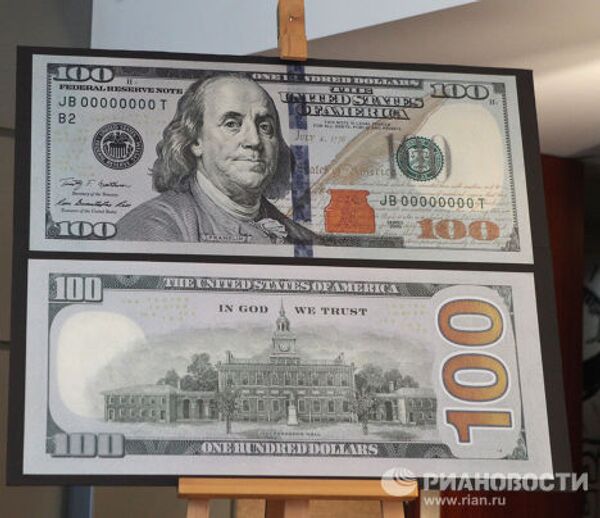
The portrait watermark of Benjamin Franklin, the security thread and the color-shifting 100s are the security features that were retained from the previous $100 bill. Quotations from the Declaration of Independence have been added to the front of the note along with a depiction of the quill the Founding Fathers of the United States used to sign the Declaration.

The presentation of the new design was held simultaneously across the world, including the U.S. Embassy in Moscow. Russia is the largest holder of U.S. currency outside the United States.
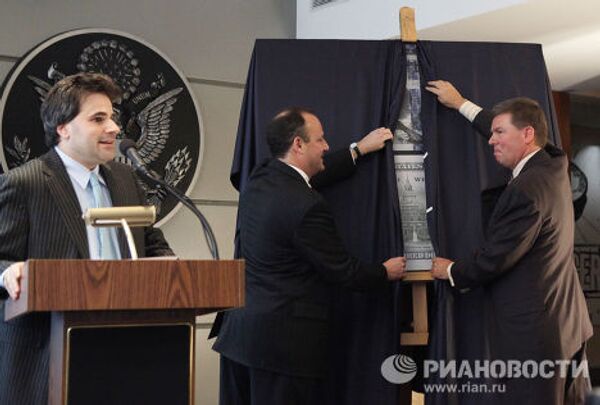
The new bill was presented in Moscow by Deputy Chief of Mission Eric Rubin (center) and Economic Advisor of the U.S. Embassy Matthias Mitman (right). The U.S. currency is widely used by Russian citizens to accumulate savings. In addition, U.S. currency is very popular among tourists, Eric Rubin said.
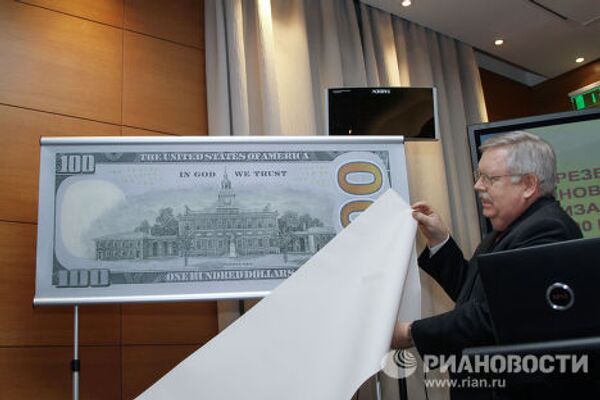
The $100 bill is the largest circulating denomination, which means it is often subject to counterfeiting. Up to 0.01% of the entire amount of U.S. currency in free circulation is fake. In the photo: U.S. Ambassador to Ukraine John F. Tefft at the presentation of the new $100 bill design in Kiev.

Production of the new bill costs 14 cents, which is 3 cents more than the old bill. The $100 bill is the last denomination reissued in a new design. A new $20 bill was introduced in 2003, followed by the $50 bill in 2004, the $10 bill in 2006, and $5 bill in 2008. In the picture: U.S. Ambassador to Ukraine John F. Tefft, left, and Oleg Dashchenko, National Bank of Ukraine Executive Director on Currency, at the presentation of the new design of the $100 bill in Kiev.