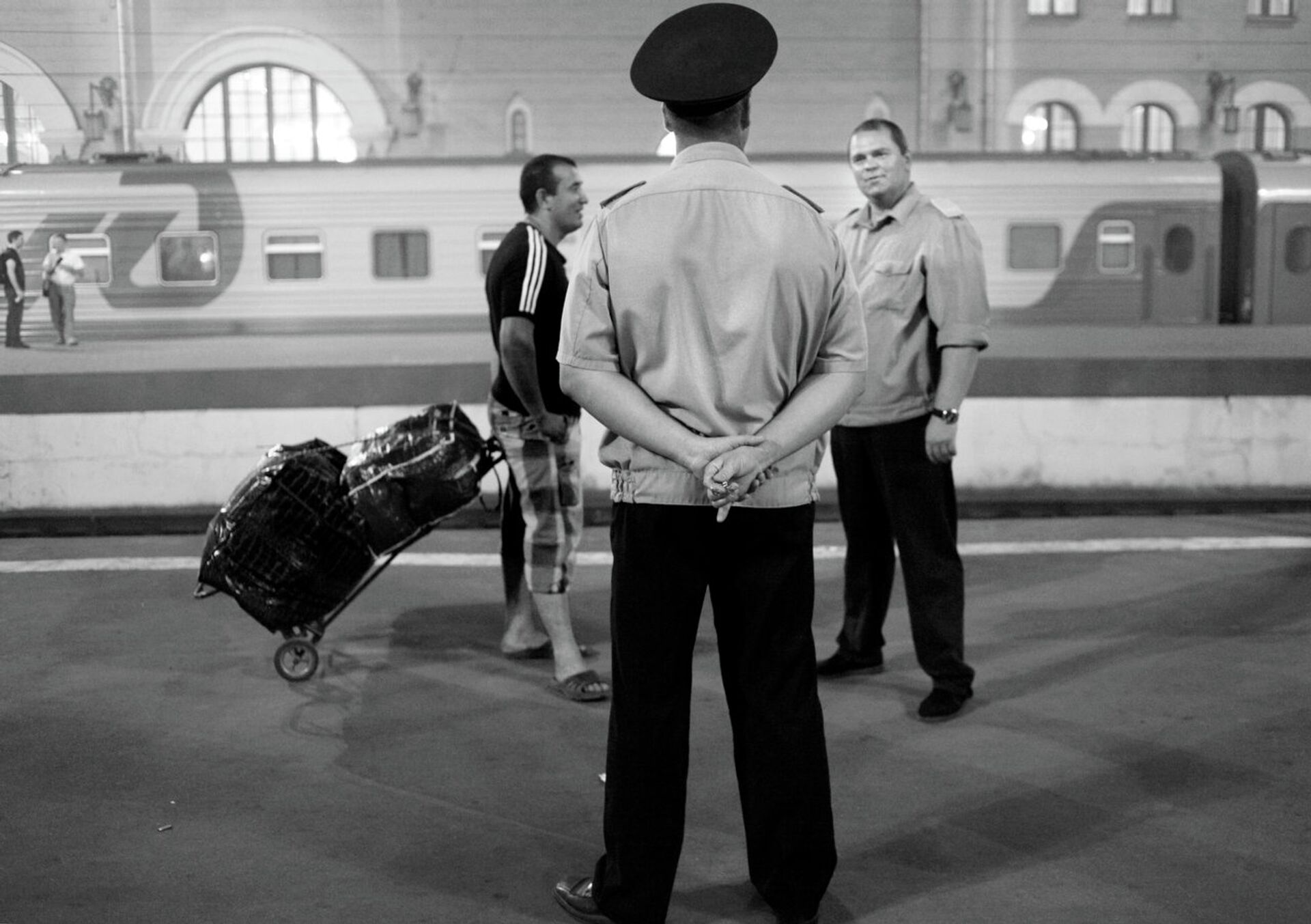
It took the seven Uzbek men four days to arrive in Moscow by train from Tashkent. It took the police just minutes to demand their passports and money.
The group of exhausted men, wearing overalls and greasy T-shirts, stood in panic, while police, tapping their weapons, shouted at them. Finally after ten minutes of interrogation, the men reluctantly handed them 200 rubles and practically ran out of the station in fear.
A compatriot, who sweeps the cobblestone floors at Kazansky station, shrugged at the incident.
“It happens all the time,” said the man who only identified himself as Zafar.“The police will stop you, ask for your papers. If you don’t have them, they’ll ask you for 200 rubles. If you do, they’ll still demand 200 rubles.”
An estimated 10 million migrants come each year from Central Asia and other areas of the former Soviet Union, recruited to do jobs most Russian citizens are unwilling to do. They are often hired to sweep floors, work in local markets and construction sites.
They are lured by money, which they say is often four to five times what they can earn back home.
Among them is Dilshyod, 23, a Tajik migrant who doesn’t feel comfortable revealing his surname.
The tall, frail-looking man moved to Russia three years ago and now works in the wasteland of Chelobityevo, about 20 kilometers outside of Moscow. There, he calls home a ragged shack improvised from particleboard and scraps of sheet metal. Dilshyod sleeps on the roof of the hut with three other people, in constant fear that police will find his home, and arrest him.
It has happened to him before. This year alone, authorities destroyed about 20 homes in Chelobityevo, where more than 300 migrants from Uzbekistan and Tajikistan lived. They defended their actions, claiming that the migrants were in Russia illegally, according to the Municipal Department of Internal Affairs of the Moscow Region.
“Look, there’s no life here, but we’ve made something out of it,” he says. “Every night, the police come and harass us, demanding money. Even if we have the right paper work, they still ask us for 200 rubles. It’s no life.”
Many migrant rights activists believe the Russian authorities are doing very little to help the migrants.
“They give up everything, everything to come to Russia, but what does this country do to help them?” says Bakhrom Khamroyev, an ethnic Uzbek who works for Memorial, a local human rights center in Moscow. “They end up in modern-day ghettos, where they become isolated and cannot integrate.”
The shabby village, now surrounded by barbed wire, is quietly coming back to life as migrants slowly build new homes. But migrants say they are still scared. At night, Dilshyod and his friend, Ali, also a migrant from Tajikistan, fear leaving the perimeter. They say if police catch them roaming around, they will be arrested.
“We never leave Chelobityevo,” said Ali, who has been in Russia for a year. “I have only been to Moscow once, and I remember not knowing how to use the metro. I asked a local, and he yelled at me and walked away. Why do I need that?”
Migrant workers are frequently referred to as priyezhie, or “the arrived,” or by the German word gastarbeiter, meaning “guest worker.” In a recent public survey by Levada Centre, a public-opinion institute based in Moscow, migrants were cited as Moscow’s biggest problem alongside high prices.
But like the high prices, migrant workers are an essential part of Moscow’s economy.
“With the exception of 2009 when the crisis did hit the Russian labor market, Russia has an objective need in the inflow of labor migrants,” said Sergei Guriev, president of the New Economic School and a researcher on labor mobility based in Moscow. “This results in pro-immigration lobbying by business, which is actually making temporary immigration easier.”
One suggestion, supported by the Russian Orthodox Church, is to introduce a so-called, “Muscovite Code,” a set of rules to “promote the integration” of foreigners, according to the Russian authorities. Some of the regulations would include: speaking only in Russian, not sacrificing sheep in courtyards, not cooking shashlyk in balconies, and not wearing national dress in public.
“Moscow is a city with a lifestyle based on Russian culture and centuries-old traditions, and everyone who comes to live here needs to know that,” said Mikhail Solomentsev, head of the Committee for Interregional Cooperation and National Policies of Moscow.
Not everyone is convinced the rules are meant to help migrants integrate. Khamroyev, of Memorial, believes the code of conduct is simply designed to exacerbate the tensions between Muscovites and foreigners.
“I am also a citizen of Moscow, but this code is complete discrimination,” he said. “Immigrants already don’t want anything from Muscovites; they are pretty helpless when they come here, so to push them even further toward isolation is absurd. It is completely against helping them integrate.”
But, for migrant workers like Xamza, 30, who has lived in Russia for five years, assimilation is not a top priority. His biggest concern is making money. He did not feel comfortable revealing his last name because for the last several years, he has been living illegally on the rooftops of more than a dozen construction sites all over the country. Now he is helping to build a sports complex off Taganskaya Street in east Moscow. There he shares a flimsy shack with four other workers.
“It is hard, you know, I have a wife and daughter back home and another baby on the way,” he explained about why he would endure such conditions. “My wife won’t even tell me if it is a boy or a girl. She keeps telling me if I want to know, I should come home. But, I come here [Russia] for the money. Oh, the money is so much better here,” he smiled at the thought.
The inflow of migrants is only likely to continue to rise, according to experts. Last year, the Federal Migration Service in Moscow announced that it had created a new center to help the growing number of migrant laborers assimilate, according to the U.S. embassy’s recent report on Human Rights in Russia. Service director Mikhail Tryukhin estimated that the center would be able to process 4,000 clients a day.
But, many experts believe it will take more to help migrants assimilate.
“I do expect the number of migrants to grow, but the greatest challenge is assimilation,” said Guriev of the New Economic School. “Will Russia be able to become a tolerant society where the drastic increase in immigration does not result in the irreconcilable ethnic divides?”
For Dilshyod, a new center in the country’s capital does little to help him feel integrated with the Russian society.
“It is the people,” he scowled in disgust. “They have a certain attitude, and they show that they just don’t want you in their country.”
By: Diana Markosian