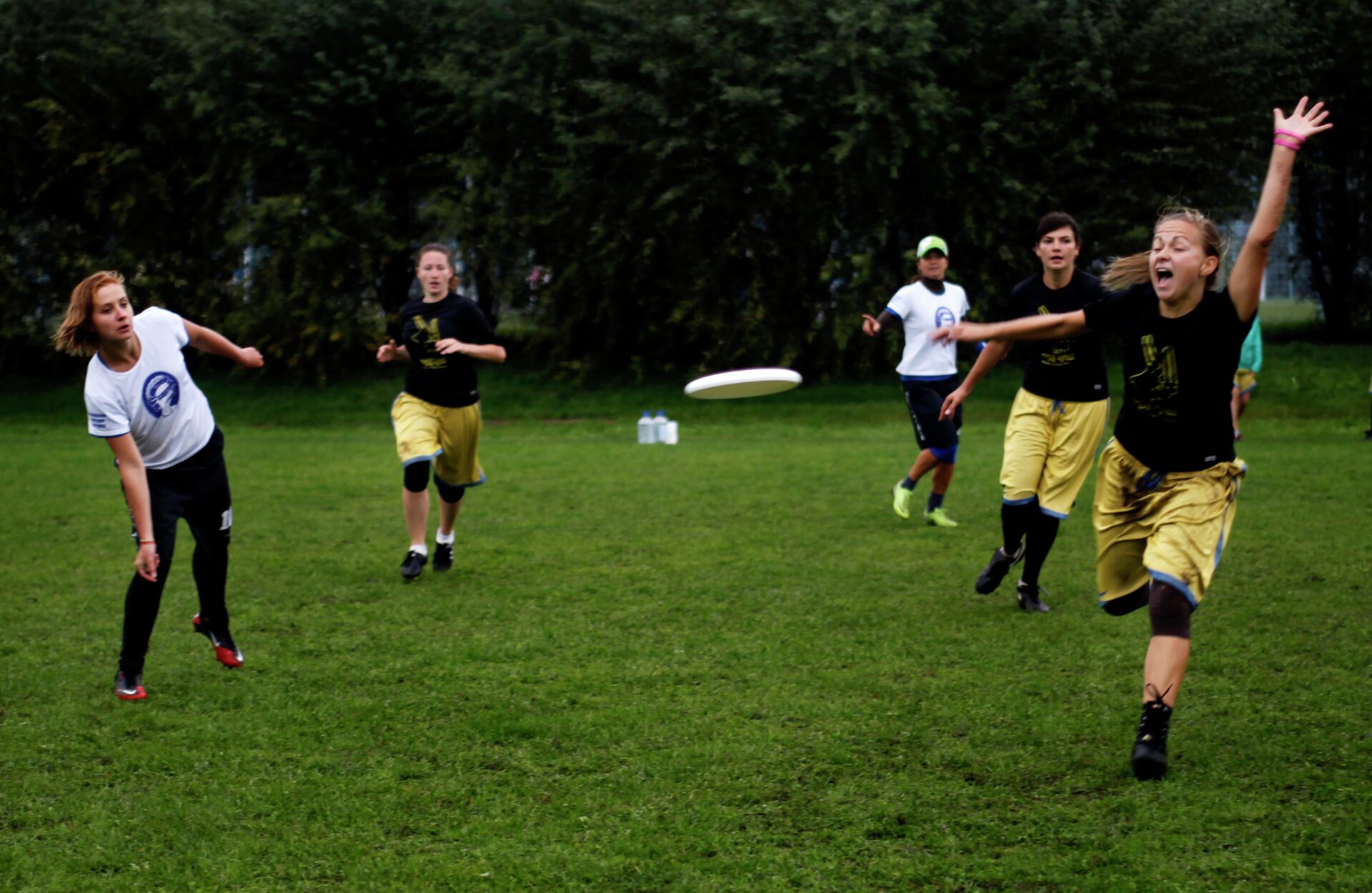
Picture a damp field in a small town south of Moscow. Then picture a line of Russian girls, soaking wet and covered in mud, one of them clutching a white plastic disc, soon to be set soaring into the air.
The women’s finals of Russian National Ultimate Frisbee Championships is about to begin.
“This is the biggest event of the year for us. We’ve been training for months,” says Ekaterina Barabanovna, one of the organizers of the event. “Over 400 players have come from as far away as Belarus and the Urals.”
The game, which is a mix between netball and American football, was invented at U.S. universities in the 1960s; 50 years on, it is rapidly gaining momentum in Russia
“Every year we are seeing more and more people getting involved and the average age of players is getting ever younger,” says Dimitry Fakeev, founder and former captain of Moscow team Dolgorukie.
Fakeev says most newcomers are students who are attracted to the quirky, easy-going nature of the sport. Teams are allowed seven players on the pitch at a time and their aim is to pass the frisbee into the defending ‘endzone’ without dropping it. The first team to score 15 points wins the game.
One of the game’s defining features is that it is played without a referee and all disputes and fouls have to be worked out amongst the team members themselves. Awards are even given for good spirit.
Ultimate Frisbee was imported to Russia in 1989 by Canadian and U.S. exchange students in St Petersburg. Playing in Russia at that time was not easy. Frisbees were hard to get hold of and budding players had to rely on expats bringing discs over from the West.
“The sport could only stay alive while good frisbees were available,” says Georgiy Fyodorov, who started playing in St Petersburg in the early 1990s. “When they were lost or broken, the teams were lost with them.”
Women’s ultimate emerged around 2001 but has only fairly recently begun developing properly, according to Lisa Woodson, an American who helped set up the first Moscow women’s team. She says it was difficult in the beginning to encourage women to play competitively.
“There were ‘technical difficulties’ too -- back in those days it was hard to find sports bras in Russia,” she says.
Although both frisbees and sports bras are now readily available in Russia, the sport still faces many of the same problems as other minority sports in the country, namely facilities and funding.
Inga Ivakina, the 19 year-old captain of Moscow women’s team, Brilliance, says fitness centers and well-equipped sports halls are too expensive in Moscow. Competition for indoor sports halls is high in the chilly Russian winters and players must travel miles outside the city to find a grassy field to play on in summer.
The situation may improve, however. A federal program for the development of sports from 2006-2015 envisages the construction of more than 4,000 sports areas in Russia at a cost of around 100 billion rubles ($3.2 billion).
The program is aimed at giving all areas of the population the opportunity to take part in sports, Head of the Federal Agency for Physical Culture Vyachislav Fetisov says.
Currently all tournaments are organized and funded on players’ initiative and out of their own pockets. National tournaments can be organized fairly cheaply but players must also venture abroad if they want to develop new skills from more experienced international teams.
This year three Russian teams took part in the World Ultimate Frisbee Club Championships in Prague. The 60 or so Russian players each forked out around $1000 on tournament fees, flights and accommodation, almost double the average Russian’s monthly salary.
Head of the Russian Olympic Press Service Sergei Averyanov says new sports only get funding from the government when they have amassed enough popularity in the country and have proven they are worth supporting.
“Take snowboarding for example. A few years ago, it was a minority sport, and now it is on the Russian Winter Olympics program,” says Averyanov.
But does ultimate with its several hundred followers have what it takes to break the barrier between minority and mainstream sport in Russia?
At the moment, the growth of the sport looks inevitable. Many of Russia’s top players have already begun teaching the sport to school children and new teams are springing up in more and more remote areas of the country.
“There’s a lot of room for further development. Getting sponsorship isn’t difficult if we take the right attitude and keep pushing for it,” Moscow player Varvara Sevostyanova says.