Russia’s Youngest Cities Are Monuments to the Energy Industry
RussiaProfile.Org, an online publication providing in-depth analysis of business, politics, current affairs and culture in Russia, has published a new Special Report on Russia’s cities and problems of urban development. Fourteen articles by both Russian and foreign contributors examine issues such as municipal government, urban planning, construction and ecology, as well as current developments in Grozny, Magnitogorsk, Vladivostok, Kazan and Sevastopol. The following article is part of this collection.
Contemporary Russia has a peculiar predilection for creating new settlements. With the exception of Peter the Great’s grandiose city on the Neva, the trend is historical and is responsible for the growth of hundreds of single-factory towns that dot the nation’s sprawling landscape today.
Fifty-three odd years ago the need to create a nuclear power plant in the Leningrad Region also led to the creation of the city of Sosnovy Bor (Pine Forest), the youngest town in northwest Russia and a successor to older industrialization-led agglomerations such as Novocheboksark. Deposits of natural resources such as crude oil, steel, cement and even a concentration of intellectual resources still have the potential to spur the creation of new cities, settlement-to-city transformations and conurbations.
Young cities like Noyabrsk, Nefteyugansk, Novocheboksark and Khanti-Mansiysk are also indicative examples of settlements that sprang up on the conflation of Russia’s burgeoning private enterprise’s interests and the government’s desire to facilitate a crying need for development. Nefteyugansk and Noyabrsk, for example, were conceived on a grand scale, along with oil production facilities, and are evidence of the private sector’s interest in the industrial development of the country. The success of these cities, however, hinges on getting the federal government to create a congenial investment climate to lure private investors and multinationals, who experts say are the only catalyst Russia desperately needs to trigger more such initiatives.
Power hunger
But other young cities like Desnogorsk were created primarily to satisfy the country’s hunger for energy and power. A seven-hour commute from Moscow would land a curious visitor in Desnogorsk, which is located on the right bank of the Desna River, southeast of Smolensk. Desnogorsk owed its birth to the Smolensk Nuclear Power Plant, which was built in 1974. The nuclear power plant is not just an urban development enterprise for Desnogorsk—it provides a third of the Smolensk regional budget. In a city where half the population has higher university degrees, the nuclear station is the largest employer, giving jobs to over 6,500 people including 1,000 so-called “elite operational staff” involved in the maintenance of nuclear reactors.
With a population of just 32,100, according to 2005 estimates, it is hard to call Desnogorsk a city, even though it received the status of a township in 1989, in the dying days of the Soviet Union. One eye-catching feature of this young city, where the average age is 38 years, is the large number of young mothers with babies or children of nursery and kindergarten age, playing in the playground in the heart of the city. Indeed, despite the gloomy demographic projections about the extinction of Russia, Desnogorsk, like other young cities, is experiencing a real “baby boom.” Ivan Gubin, the city’s chief medical officer, said the birth rate in the city has exceeded the death rate by eight percent since January 1, 2005.
Haphazardly arranged drab and gray Soviet-era apartment blocks line the wide expanse along the bank of the Desna, giving first-time visitors the impression that they were put up without rhyme or reason. But locals said the beauty of such a haphazard arrangement is that it allows winds from the city’s birch trees and maples to waft through its high-rises throughout the city. Gubin calls this “the most environmentally conscious building arrangement” in view of the Smolensk Nuclear Power Plant, which threatens the city’s urbanized landscape just three kilometers away.
Desnogorsk is perhaps the greenest of Russia’s youngest cities. Its main street is called Broadway, after an industrial-goods department store located at the very beginning of the street, rather than an allusion to the famous street in New York. There is also a Novy Arbat Street, home to three 16-storey buildings. The city’s most attractive landmark is a church, hewn from birchwood and dedicated to St. Stephen Velikopermsky.
But as the town grows, local authorities are increasingly taking more responsibility for security and social objects from the leadership of the atomic station, City Mayor Mikhail Khobotov said. His optimism for the future of this budding city, he said, is based on having more non-nuclear industries and businesses. Khobotov expressed delight that a previous ban on the construction of new enterprises within a 30-kilometer radius of the plant has been lifted, opening the gate to construction of new factories that could create jobs and boost the budget. It is a slightly different situation in Noyabrsk, another one of Russia’s newest cities.
Of rags and riches
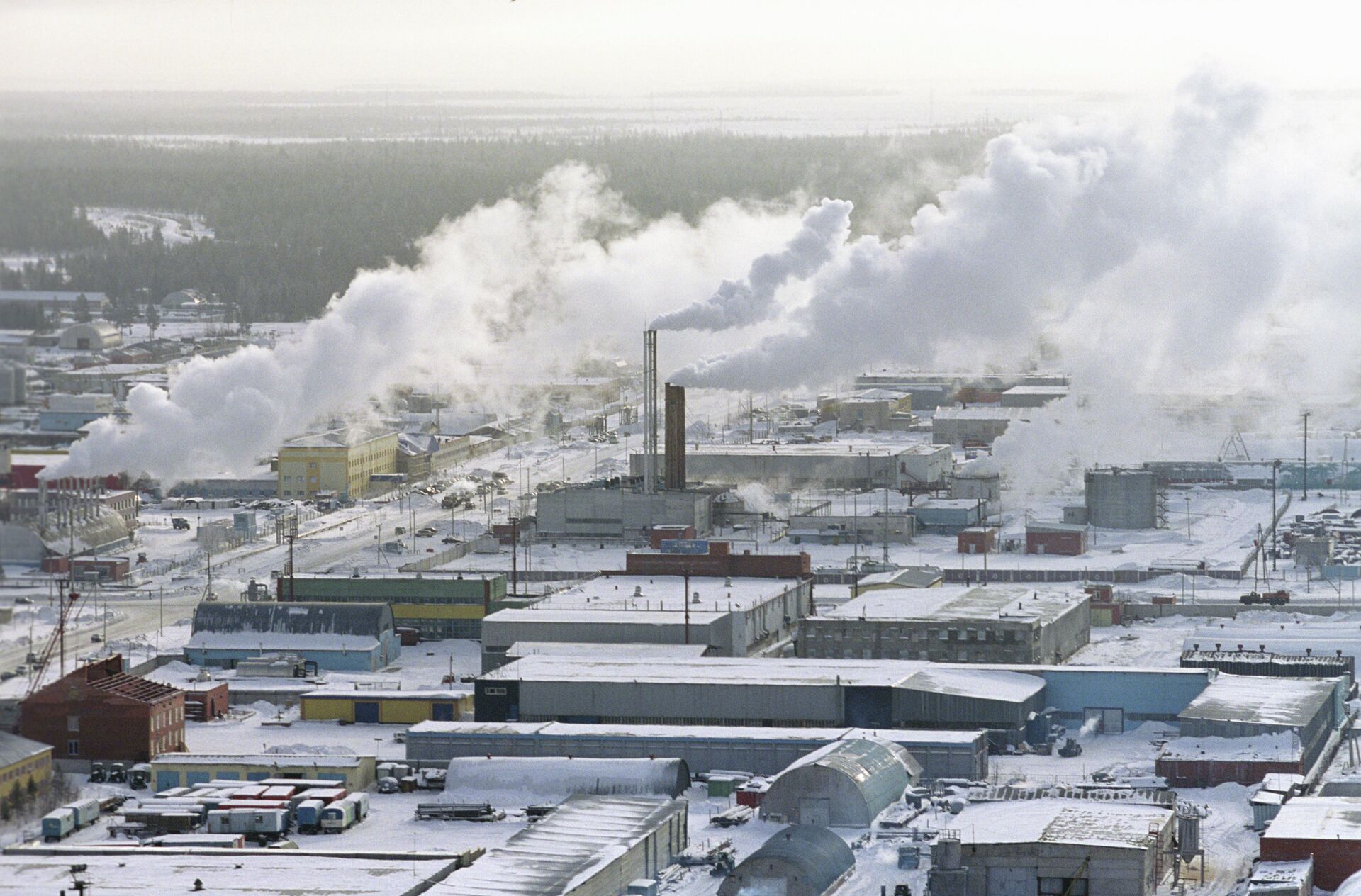
Just 300 kilometers north of Surgut, in the middle of the Siberian wilderness, the city of Noyabrsk, whose economy is based entirely on hydrocarbon production, is struggling to make its mark. Noyabrsk, the largest town in the Yamalo-Nenets Autonomous District, was founded by a group of fortune-seekers who arrived by helicopter on the icy Itu-Yakha River to start developing the Kholmogorskoye oil field in 1975. In November 1976, a group of railway builders arrived at the site of the future town and camped out by Lake Khanto with the task of creating a settlement. On October 26, 1977 the settlement of Noyabrsk, which grew around the railway station of Noyabrskaya, was officially registered. The settlement was granted the status of a work settlement on November 12, 1979, and that of a town on April 28, 1982. Sporting an average age of 30, the city has grown from 68,000 in 1989 to 108,500 in 2006. High salaries, privileged living conditions and pioneering pride attracted some of the Soviet Union’s most highly skilled engineers to work in this hostile environment, where temperatures often plummet to negative 50 degrees Celsius. Wages here average $ 750 per month, or five times the average Russian salary, and people are confident about the future.
The prosperity of Noyabrsk is entirely dependent on the prosperity of two major oil and gas companies—Gazpromneft—Noyabrskneftegaz, a major oil producing subsidiary of Gazprom Neft, and Gazprom Dobycha Noyabrsk, another leading Gazprom subsidiary. Gazpromneft—Noyabrskneftegaz is the largest oil company in Yamalo-Nenets Autonomous District and accounts for six percent of Russia’s total oil production, while Gazprom Dobycha Noyabrsk has an annual production of 85 billion cubic meters or about 9.3 percent of Gazprom’s total yearly gas production. These two national champions, Noyabrsk administration officials say, have brought economics of scale to the city, enabling over 1,000 companies that provide services for the oil and gas industry and support the social infrastructure of the city.
However, Russia’s free market transition has brought new economic realities to Noyabrsk and added to the worries of the people who live here. To cut costs, Russian oil companies are removing some of the perks traditionally enjoyed under communism. The oil companies that have been running the town’s social infrastructure, including everything from hospitals to buses, said it is no longer their business and have handed these responsibilities over to the local administration. The administration has since had to privatize some social services to help balance the budget, and started charging local residents for basic services like heating and maintenance. “People are now trying to cut their living expenses, to give up certain services, but they can’t give up things like heating,” said a city official who spoke on the condition of anonymity because he is not authorized to discuss the issue.
Widespread drug abuse is another headache that the city administration is having to cope with. Noyabrsk, which was a partially closed town during the Soviet era, has for most of its history had a predominantly professional working population, which provided some protection from external criminal influences. But with its opening in the early 1990s and the oil and gas industry maintaining relatively high living standards in the economic turmoil of post-Soviet Russia, the illicit drug business became highly profitable, drawing criminal elements from other regions. Widespread corrupt practices have been reported in the police force and high youth unemployment means that many are turning to crime. One symbol of how crime-infested the city has become is the ubiquity of metal bars on ground-floor residence windows and five millimeter-thick steel sheeted apartment doors, indicating a continuing burglary issue. Used syringes and hypodermic needles are a common sight in parks and outside public offices.
There will be blood
Nefteyugansk, a city in the Khanty-Mansiysk Autonomous Region, is another young city where the theme of crime and punishment has done more to put the city on the map than its rich oilfields. Located south of the Ob River, close to the larger city of Surgut, Nefteyugansk became a city in 1967 after a group of engineers discovered an oilfield in a small forest clearing in the middle of the taiga marshland in 1961. Yuganskneftegaz, which was founded in February 1966, became the dominant enterprise in this city of 108,000 residents. The now-defunct oil company Yukos took the first two letters of its name from Yuganskneftegaz, which it owned. Before Yuganskneftegaz was fully established, Nefteyugansk was a grim Siberian outpost with lines of concrete dormitory blocks dumped on the banks of the River Ob. Today, the city has a new sports hall and modern ultrasound equipment in its hospital, as the company strives to demonstrate that it can be socially responsible.
But the city’s history has also been tainted with crime. In June 1998, the mayor of Nefteyugansk, Vladimir Petukhov, was shot dead, and Alexei Pichugin, a Yukos employee, was charged with the murder. Petukhov was known for his virulent criticism of the oil company. On September 20, the Deputy Mayor of Nefteyugansk Dmitry Yegortsev was assaulted and wounded with a knife. Another Deputy Mayor, Igor Gribanov, died in a fire at his home in 2006. Yuganskneftegaz was acquired by state-owned Rosneft and fully integrated into the company’s production infrastructure in 2005. It has since become the company’s largest oil-producing enterprise, with 26 oil fields in the Khanty-Mansiysk Autonomous District of Western Siberia.
Since acquiring Yugansk at the expense of Yukos, Rosneft has gone from a mid-tier company to the country’s favored oil champion, with nearly 15 billion barrels in proven oil reserves, putting it just behind privately held LUKoil. Rosneft hopes to raise output to two million barrels per day by the end of 2010 and to 2.8 million barrels per day by 2015, up from the current 1.75 million barrels per day. “Stability” was the word of the day in meetings with officials from Rosneft, Yugansk and the Nefteyugansk city administration. Sergei Karaganov, Rosneft’s vice president for social affairs, said: “People are quite confident in their future now. There are no longer problems with hiring, without even regard to salaries—people are looking for stability.” Karaganov said wages at Yugansk, the highest in Rosneft’s empire, had increased by 35 percent since 2004, averaging $ 1,850 per month.
Nuclear options
Sosnovy Bor, or Pine Forest, is clearly the youngest and cleanest town in Northwest Russia, situated as it were among the pines and dunes on the shore of the Gulf of Finland. The city was founded in 1958 as a settlement of engineers and scientists to cater for the Leningrad Nuclear Power Plant and received town status in 1973. Although one of the most beautiful cities in the Leningrad Region, Sosnovy Bor is yet another “atomgorod,” or nuclear city, whose past, present and future are inextricably linked to the Leningrad Nuclear Power Plant. Sergei Kiriyenko, the head of the Federal Atomic Energy Agency, said recently that Russia would have to build a total of 40 new reactors to fulfill the goal. He said that the ambitious program would kick off with the launch of construction next year of a new nuclear power plant near St. Petersburg, to be located next to the existing nuclear plant in Sosnovy Bor. However, a combination of geography and abundant forest resources has helped the city to shun total reliance on the nuclear power plant. The town now features many research institutes and a building industry supported in part by its forest reserves. There are about five hundred large, medium, and small enterprises functioning in the town, many of them technologically oriented. But with nuclear power accounting for 17 percent of Russia’s electricity generation, and the Kremlin setting a target to raise its share to one-quarter by 2030, the future of young cities like Desnogorsk and Sosnovy Bor will continue to be tied to the nuclear industry they were created to serve.