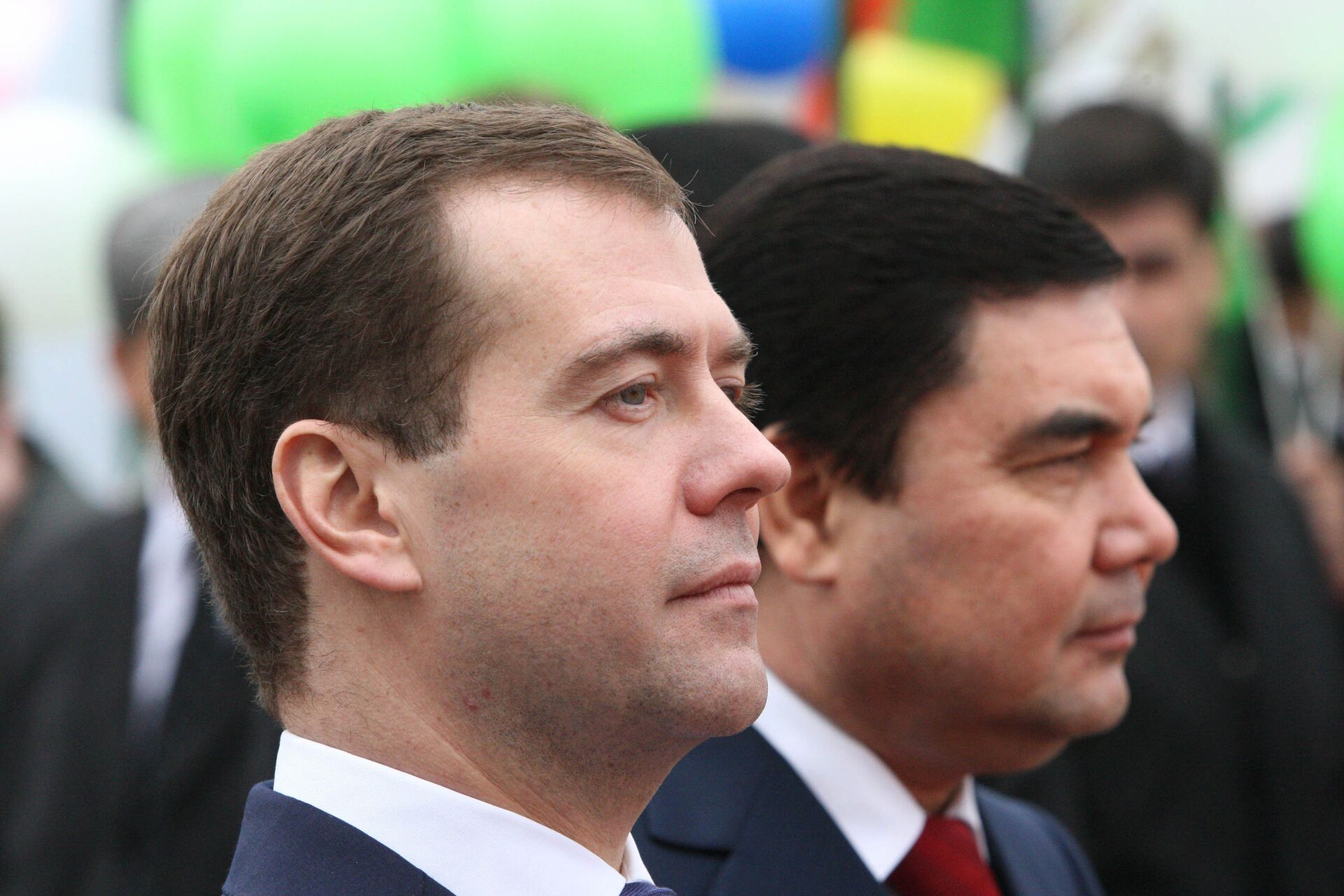
Russian-Turkmen relations can hardly be called cloudless. That's why analysts had every reason to expect Russian President Dmitry Medvedev's recent visit to Ashgabat to be swathed in intrigue.
These expectations were, it appears, quite justified. Although Turkmen President Gurbanguly Berdymukhamedov has said he is ready to deliver more natural gas to Russia, this statement somewhat contradicts Ashgabat's policy to date of diversifying its gas supplies.
In 2009, this Central Asian republic, which boasts the world's fourth-largest gas deposits, finished building a gas pipeline to China and also expanded its gas deliveries to Iran. Turkmenistan is also actively involved in European supply projects aiming to grant Europe access to Asia's natural resource wealth while circumventing Russia.
The promises that Berdymukhamedov has made may seem, at first glance, unexpected, but they have one simple explanation: Ashgabat's new clients are even less malleable than their longtime customers.
China, for one, is in no mood to back down on price. In the first quarter of 2010, Beijing paid $120-140 per thousand cubic meters of Turkmen gas, while Moscow paid $195. Russia will buy just ten billion cu. m. of Turkmen gas this year because the calculated price was even higher, at $240 per thousand cu. m.
Turkmenistan has expedited work on the East-West pipeline, due to transport gas from its largest gas field, South Yolotan, to the Caspian coast. The pipeline transports gas from Turkmen deposits to the continental shelf and on to Europe via the Trans-Caspian or Pre-Caspian gas pipeline, but that's not all. As a two-way pipeline, it can also deliver gas from Turkmenistan's shelf deposits to the country's Asian consumers that lie beyond its eastern borders. Moreover, compressed Turkmen gas can also be shipped by tanker.
The deliberate decision to expedite construction on the East-West pipeline highlights Ashgabat's desire to persuade the European Union to ramp up work on the Nabucco pipeline project and to delve further into trans-Caspian gas-transportation options.
Turkmenistan has made it clear to Europe that it can always supply China. Similarly, Beijing is reminded that it should consider possible risks linked with the transportation of Turkmen gas to Europe.
Ashgabat now wants the EU, which is also bent on diversifying its gas supplies, to swing into action, while Brussels has no misgivings about the Turkmen experience, which shows that diversification does not always have a happy ending.
Without Turkmen gas, all these grand European pipeline projects, and particularly Nabucco, will remain on paper. They can only really lay claim to gas from Azerbaijan, which is already being fought over by a host of prospective customers.
Consequently, none of the three European projects, namely, the Nabucco pipeline, the Trans-Afghanistan Pipeline (TAP) and the Interconnector Turkey-Greece-Italy (ITGI) pipeline, have received any solid guarantees regarding gas supplies from Azerbaijan.
No one wants to buy gas without gas-transportation guarantees. And if there are no customers then investment is not forthcoming. That in turn means that no gas pipeline will be built.
The EU has virtually created a transit corridor linking Turkmenistan, Azerbaijan, Georgia and Turkey, but faces problems getting the gas across the Caspian Sea.
Italian multinational oil and gas company Eni S.p.A. proposes using tankers to deliver liquefied Turkmen gas.
However, as no such projects have yet been implemented anywhere in the world, there is little understanding of what they would involve both economically and technically. Although pipelines can be laid underwater, that approach is not an option for legal reasons, since the littoral countries have to date failed to demarcate their borders.
Yet despite all that, the idea still remains highly attractive, which is why the EU is looking for any loopholes it can find that could be used to justify pipeline construction. Rumors abounded this summer that the European Commission had drawn up a document which could underpin an agreement to build a Turkmenistan-Azerbaijan pipeline.
It was argued that this new pipeline route would be a workable option despite unresolved territorial disputes between the countries involved, including Turkmenistan and Azerbaijan.
In fact, that was only a test to gauge the Russian response. Unsurprisingly, Russia was not well disposed towards these rumored developments.
Another tactical ploy is now on the agenda. A 200-km pipeline has already been laid from the Azeri-Chirag-Guneshli oil and gas field, located midway between Azerbaijan and Turkmenistan, to the Azerbaijani coast.
The EU is seriously contemplating this option and is planning to launch construction of this section of pipeline whether or not Russia consents. That would be a glaring violation of international law from the diplomatic standpoint.
Turkmenistan is prodding Europe to act more resolutely. Ashgabat said in the run-up to Medvedev's visit that it was ready to sell gas to its European customers on the Turkmen border, with the latter then taking responsibility for delivery.
Despite these provocative statements, the EU is unlikely to confront Russia head on. Consequently, this project seems fated to remain something of a pipe dream.
Moreover, China has proved a difficult partner, insisting both on keeping the price low and that it gets Turkmen gas on highly favorable terms. It seems Ashgabat's only chance of making the Turkmen gas sector turn a greater profit is by negotiating with Moscow. Medvedev responded cautiously to Berdymukhamedov's proposal.
The question is: how ready is Russia to exploit this newly favorable situation. Russia's economy may not need additional Turkmen gas that much now, but down the line the need might arise, for example if EU gas prices skyrocket in the medium term.
Moreover, Russian companies could expand gas production in Turkmenistan and sell the gas on to China. Although this is clearly not the most immediately profitable option, it could help oust a potential rival from the European market.
Konstantin Simonov is the general director of the Moscow-based National Energy Security Foundation.
The views expressed in this article are the author's and do not necessarily represent those of RIA Novosti.