The House of Lords Constitutional Committee reported that it was unhappy that the Scottish Parliament had used powers under the Scotland Act 1998 to allow 16 and 17 year olds to vote in the Scottish Referendum. The Lords said the use of secondary legislation — powers not directly given through the UK Parliament in Westminster — was not a proper way of changing the constitution.
The issue centres on the current UK voting system, where the minimum voting age is 18. Current Westminster policy is not to lower the voting age.
Lowering the voting age can only be positive – Terri Smith MSYP, Vice Chair of the Scottish Youth Parliament http://t.co/V5YbkV4fRF
— SYP (@OfficialSYP) February 23, 2015
However, following the move in Scotland, the Welsh National Assembly has used the Wales Act 2014 to reduce the voting age to 16 in any referendum held on tax-raising powers for the Assembly.
#votesat16 really its just #commonsense — all roads are heading that way lets get go quicker #weareready pic.twitter.com/87weuhwG1A
— Votes at 16 Campaign (@votesat16) September 22, 2014
This may in turn lead to pressure to extend the franchise similarly for UK parliamentary elections, European Parliament elections and other elections in England, Wales and Northern Ireland.
Lack of Parliament Scrutiny
The Lords' report said:
"We also note that a voting age of 16 remains very uncommon around the world, and is not a change which any of the UK's main European neighbours has adopted. Nor is it known to be UK Government policy that the voting age should be lowered."
The report said constitutional matters, including the lowering of the voting age, in matters relating to UK-wide elections, should only be enacted through Parliament in Westminster: "The use of secondary legislation makes it impossible for Parliament to scrutinise this proposal effectively. This is not an appropriate way to proceed with significant constitutional change."
Lowering the voting age to 16 would be a great sign of respect for young people's voices #idebate
— Frances Black (@FrancesNoir) February 11, 2015
It said the "potentially piecemeal and incremental approach" to changing the voting age stood in contrast to the process whereby the voting age was lowered from 21 to 18 in the late 1960s.
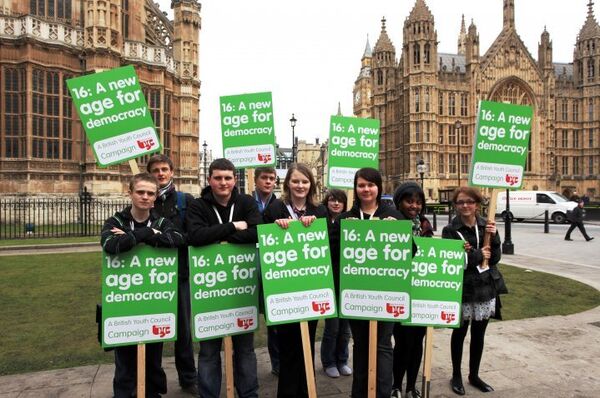
On that occasion, legislation followed the reports of two Commissions, one into electoral law and the other into the age of majority, after which the Government opted to make the voting age the same as the age of majority.
The report said that implementing constitutional change by means of secondary legislation "makes it impossible for Parliament to scrutinise this proposal effectively."
"This is not an appropriate way to proceed with significant constitutional change."
The House of Lords committee also said putting 16- and 17-year-olds onto the electoral roll could have data protection implications, as people in that age group are considered to be "minors" in law.