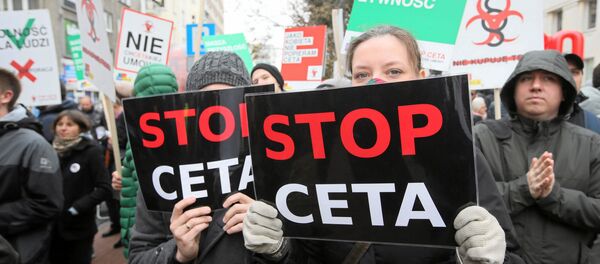
"The French speaking Socialist Party (PS), who are responsible for the situation in Wallonia, are part of the majority in the Brussels parliament. Other parties like cdH, Ecolo and Défi are against the treaty as well. We expect the Brussels PS to follow their Walloon counterparts," Cornelis, a lawmaker from Open Vld party, backing the deal, warned.
He admitted that CETA had almost no chances to be signed at the EU-Canada summit on 27-28 of October in Brussels as was originally planned with more and more EU politicians suggesting that the summit itself might be postponed due to setback by Wallonia's parliament.
"We can only hope for reason to return to the PS. We suspect it will take some time for them to change their minds. Therefore, we find it unlikely that the treaty will be officially signed on October 27," Cornelis said.
Back in July, President of the European Commission Jean-Claude Juncker under the pressure of French and German left parties designated CETA as a “mixed agreement” that requires ratification in Europe’s 38 national and regional parliaments. That means that despite the Belgian national government and the dominant Dutch-speaking region of Flanders backing the deal, it cannot be signed without the consent of Walloon and Brussels regional parliaments.
The negotiations on establishing a free trade zone between Canada and the European Union, scrapping more than 98 percent of the existing tariffs between Ottawa and Brussels, were launched in 2009 and concluded in August 2014 with the requirement that the agreement must be approved by the Council of the European Union, the European Parliament and all EU member states. Opponents fear CETA would undermine standards and regulations on environmental protection, health, safety and workers' rights.