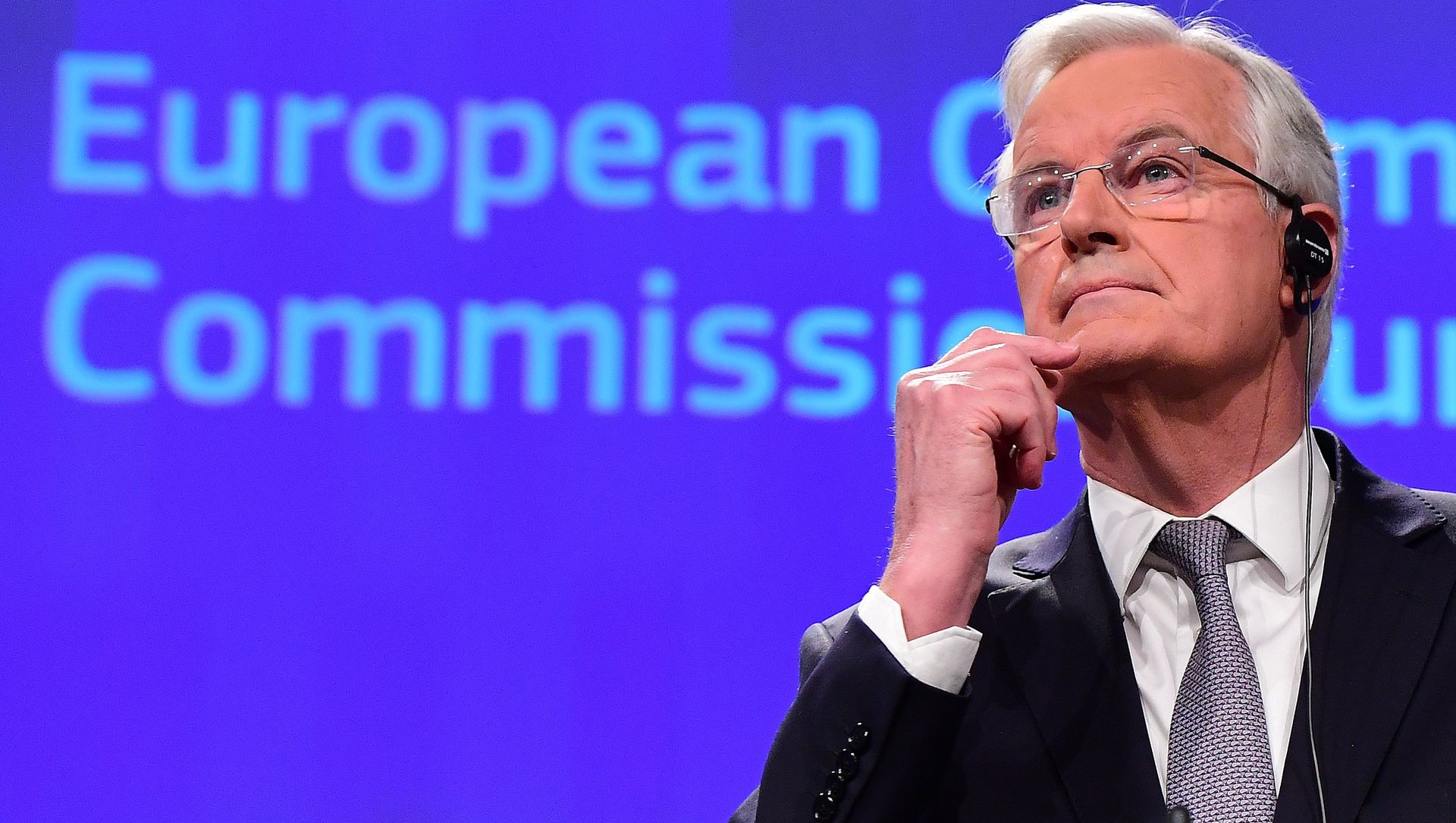
In an extremely blunt appraisal of the impending Brexit talks — which have yet to be officially started by Britain — Barnier said:
"Time will be short. It's clear that the period for actually negotiations will be shorter than two years."
Under Article 50 of the Treaty of Lisbon, Britain alone must trigger the process for leaving the EU — a process which UK Prime Minister Theresa May has said would be by the end of May 2017 — after which the negotiations have a two-year limit, under the treaty, which may be extended, by agreement.
However, Barnier said that two-year period — he made no mention of the extension allowable under the treaty — would be shorted at the start and the finish.
"At the beginning, the two years includes time for the European Council to set guidelines and for the Council to authorize negotiations. At the end, the agreement must, of course, be approved by the Council, the European Parliament and — finally — the UK Parliament. All within the two-year period.
"Time will be short. The period for actual negotiations will be shorter than 2 years." @MichelBarnier #Brexit pic.twitter.com/AGMceDr9Ya
— European Commission (@EU_Commission) 6 December 2016
"All-in-all, there will be less than 18-month to negotiate. Once again, that is short. Should the UK notify the Council be the end of March 2017, as PM Theresa May said she would, then it is safe to say that the negotiations could start a few weeks later and an article 50 agreement be reached by October 2018," he told reporters in Brussels.
Barnier — once dubbed "the most dangerous man in Europe" by the London Daily Telegraph newspaper — was giving his first detailed briefing of his role since being appointed to lead the Brexit talks on behalf of the European Commission.
He was European Commissioner for Internal Market and Services, dealing with the reform of the financial sector, the banking union and the digital single market. As such, he is seen by many as a 'Brussels man' through-and-through.
'No Cherry-Picking'
He made it clear that any negotiations with the UK would be based on four principles — effectively laying down prenegotiation rules ahead of Britain triggering Article 50.
What are the 4 principles that will guide the negotiation with the UK 🇬🇧? ➡️ @MichelBarnier, Chief negotiator #Brexit pic.twitter.com/mYDvESUJU6
— European Commission (@EU_Commission) 6 December 2016
"Unity is the strength of the European Union and [Commission] President Jean-Claude Juncker and I are determined to preserve the unity and interest of the EU 27 in the Brexit negotiations."
"Second. Being a member of the EU comes with rights and benefits. Third countries [i.e. the UK post-Brexit] can never have the same rights and benefits, since they are not subject to the same obligations.
He said that, thirdly, negotiations will not start before Article 50 has been officially notified by the UK. However, his bluntest comment came when he outlined the fourth principle.
"The single market and its four freedoms [of movement of people, goods, services and capital] are indivisible. Cherry-picking is not an option," he said, referring to reports that the UK might choose to remain as part of the single market, despite public opposition in Britain to unfettered immigration.
The fact that Barnier has made clear that he is looking at March 17 as the preferred start date — which is by no means possible for Theresa May — and is talking of a curtailed two year period of negotiations, suggests he and Juncker are looking for a swift conclusion to Britain's membership of the EU. On their terms.