Russia Developing Combat Exoskeletons, Testing Them in Syria – Photos, Video
10:27 GMT 28.08.2021 (Updated: 11:36 GMT 28.08.2021)
© Sputnik / Evgeny Odinokov
/ Subscribe
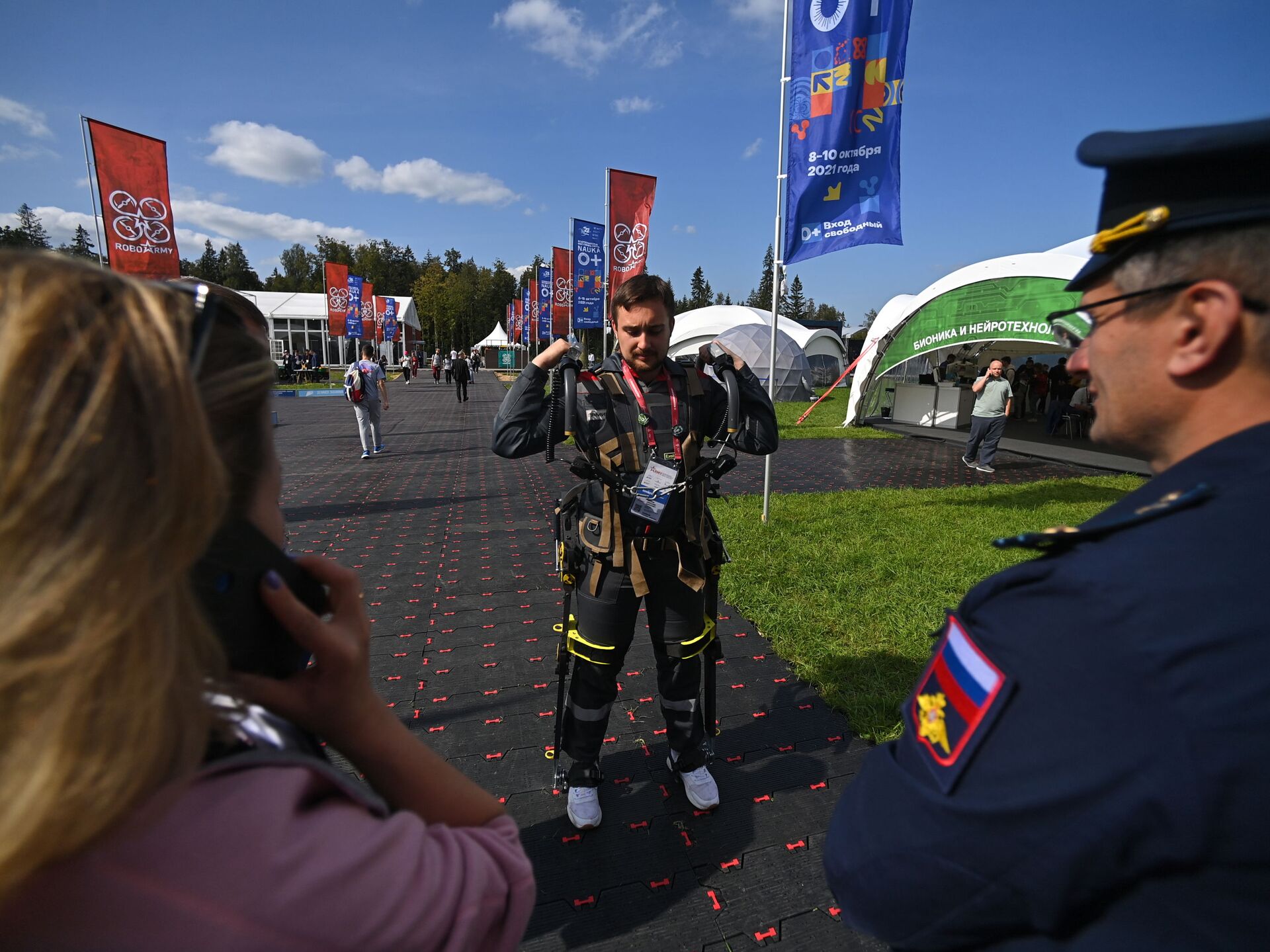
Several countries are known to be experimenting with combat exoskeleton technology, which typically consists of a wearable machine powered by electric motors, pneumatics, or hydraulics that dramatically augment soldiers’ strength and endurance characteristics by amplifying the power of their limb movements.
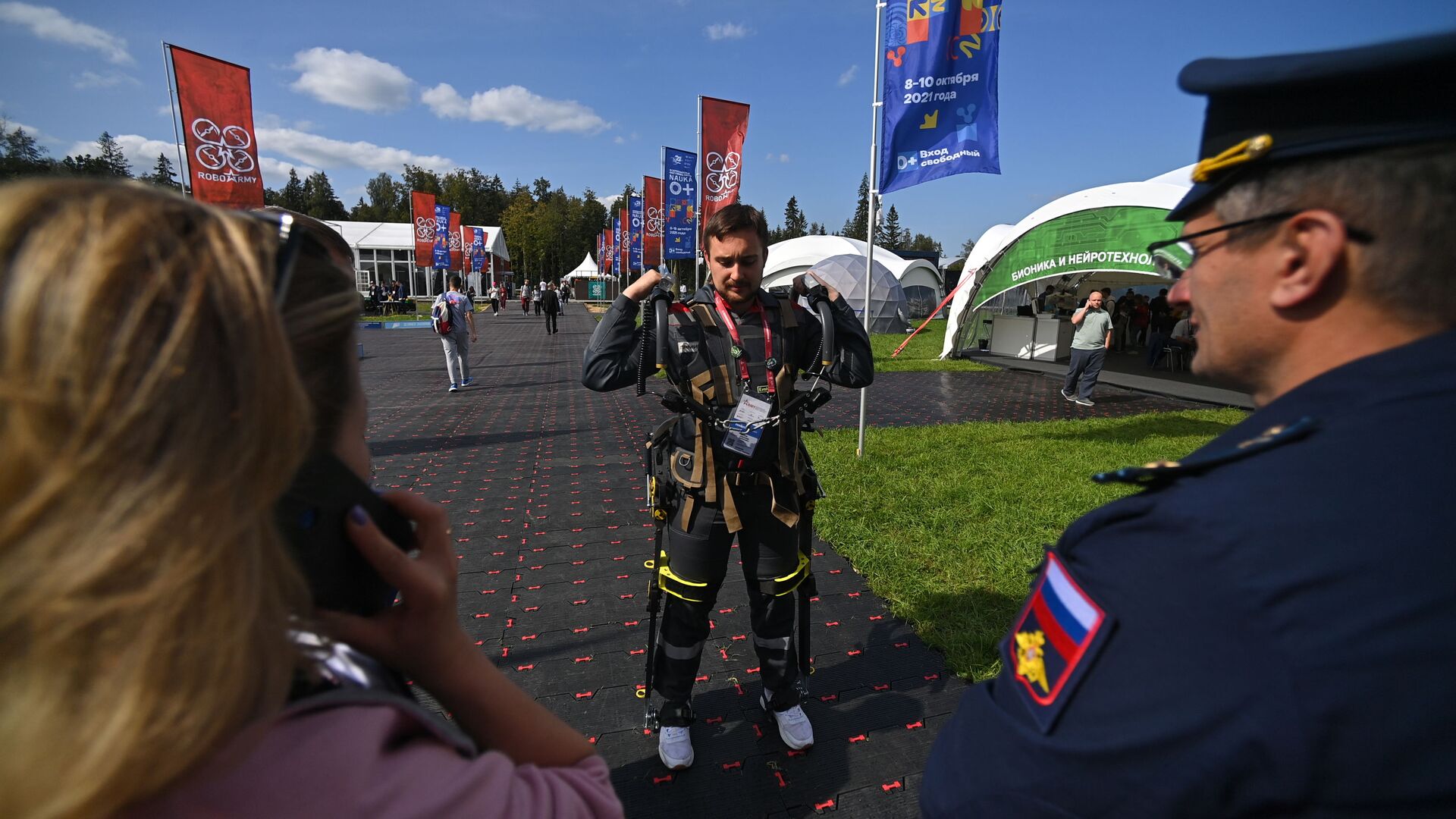
Russian engineers have created the first prototype of a combat exoskeleton equipped with electric motors, revealed Bekhan Ozdoev, industrial director of Rostec State Corporation’s division for armament, ammunition, and special-purpose chemistry.
“The exoskeleton which we are creating with our colleagues from the Research Institute of Mechanics at Lomonosov Moscow State University reduces the load on the musculoskeletal system by 50 percent, energy consumption when running or walking by 15 percent, allows the wearer to carry up to 60 kilograms of cargo and fire automatic weapons with 20 percent greater accuracy,” Ozdoev explained, speaking to Sputnik on the sidelines of the ongoing ARMY-2021 military expo and forum outside Moscow on Saturday.
The company official says the exoskeleton is capable of operating in two modes – "active" and "passive." In active mode, battery-powered gearless electric motors serve to enhance the wearer’s physical capabilities. The system is activated when a soldier is moving through rough or mountainous terrain. Passive mode is designed for movement over a flat surface with gear.
The exoskeleton’s servo motors include position sensors, as well as pressure sensors in the feet area, which ensure that the exoskeleton adapts to the wearer’s movements.
Along with the Research Institute of Mechanics, Rostec subsidiary TSNIITochMash (the Central Research Institute for Precision Machine Building) is involved the creation of the exoskeleton.
Vladimir Budanov, the head of the laboratory of general mechanics at the Research Institute of Mechanic, indicated that future versions of the system will include the use of composite materials and other modifications to improve power supply and the control system.
Exoskeleton-Equipped Troops Already Operating in Syria
An unnamed representative of Rostec also revealed to Sputnik at the forum that Russian-made combat exoskeletons have already been deployed in Syria among sapper units, where they are said to have increased the combat potential of individual soldiers and entire units.
The official said the exoskeletons used in Syria use passive technology. In other words, they are not equipped with electric motors but the mechanics of their design allow them to reduce the load on the wearer’s musculoskeletal system, thereby allowing him to carry loads over greater distances.
Russia has deployed hundreds of sappers to Syria over the years to clear mines left behind by terrorist militants, with troops operating in urban and rural areas and helping to safely clear ancient sites, including the archeological site at Palmyra in central Syria.
Soldiers of the Future
Russian engineers aren’t the only ones working on powered and passive exoskeletons for military use. The United States and China are also known to be working on the futuristic technology, which until a few decades ago was considered the domain only of science fiction.
5 October 2019, 00:44 GMT
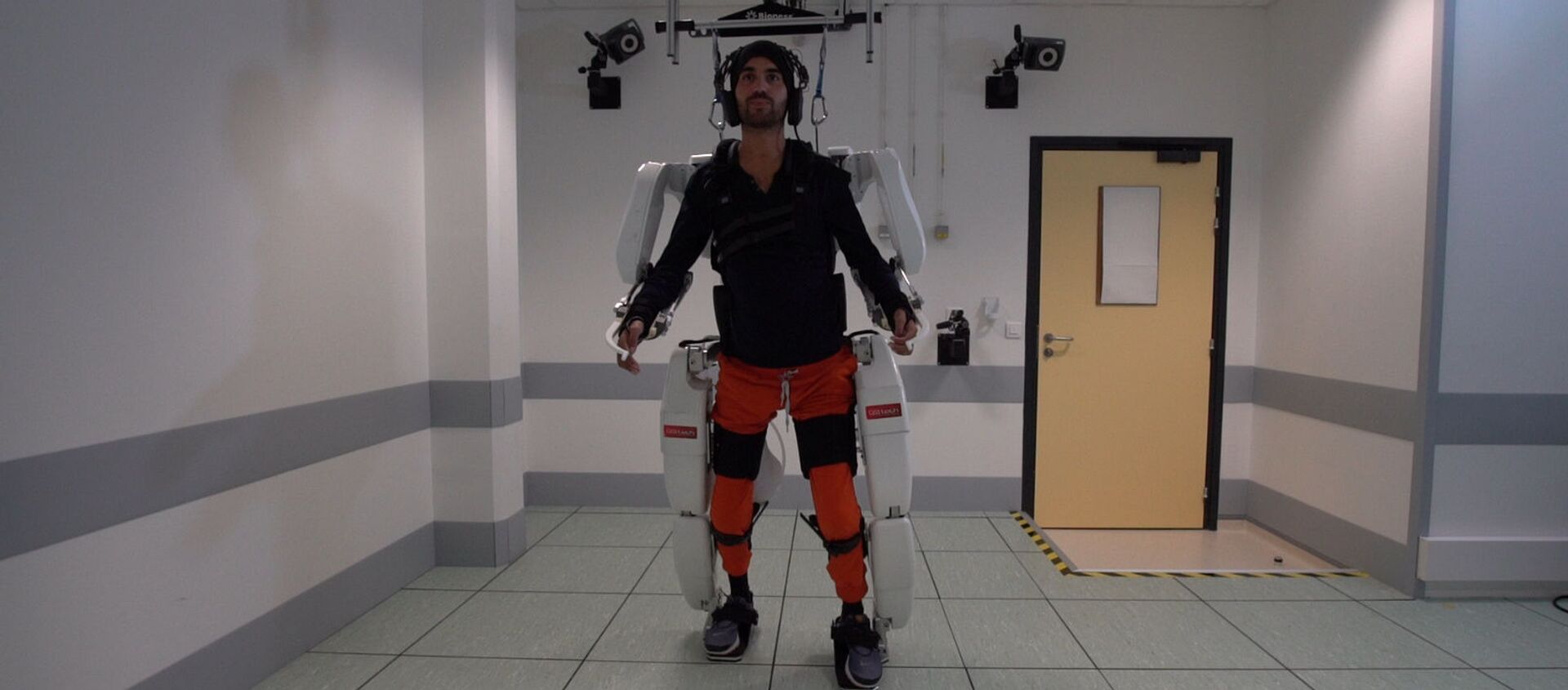
In addition to military applications, exoskeletons have a number of other potential uses – including in medicine (assisting individuals who suffer from debilitating conditions which limit their ability to move independently) – among rescue workers and firefighters, and in industrial applications.
Although they have only become a reality in the 21st century, exoskeletons are something scientists and writers have mulled over for well over two centuries. Russian engineer Nicholas Yagin patented the world’s first working exoskeleton apparatus to assist with movement in the 1890s, with the passive device using energy stored in compressed gas bags to assist movement. Unfortunately, Yagin’s system never got beyond the design stage. The technology has been considered by science fiction writers since at least the 1860s, when author Edward S. Ellis imagined the idea of a humanoid-shaped steam engine which could be used to terrorise Native Americans in the Wild West in a novel entitled “The Steam Man of the Prairies.” The idea of augmented soldiers reemerged in the popular imagination in 1959 with the publication of Robert Heinlein’s novel “Starship Troopers.”