https://sputnikglobe.com/20221119/canada-will-boost-military-presence-in-indo-pacific-will-challenge-china-when-it-ought-to-1104433543.html
Canada Will Boost Military Presence in Indo-Pacific, 'Challenge China' When It 'Ought To'
Canada Will Boost Military Presence in Indo-Pacific, 'Challenge China' When It 'Ought To'
Sputnik International
Canada will boost its military presence in the Indo-Pacific region and shall challenge China when It ought to, said Defense Minister Anita Anand.
2022-11-19T14:12+0000
2022-11-19T14:12+0000
2023-06-19T12:45+0000
world
canada
china
indo-pacific
military presence
north american aerospace defense command (norad)
justin trudeau
xinjiang
xi jinping
taiwan
https://cdn.imgsputnikglobe.com/img/107065/12/1070651234_0:182:3501:2151_1920x0_80_0_0_39abea402eb2be345e11f13fa83ceef1.jpg
Canada will be boosting its military presence in the Indo-Pacific in line with a strategy that Ottawa has tailored to keep China’s growing clout at bay, Defense Minister Anita Anand stated.Canada’s ties with nations in the Indo-Pacific are all-important for its state security interests, while also beneficial for furthering goals pertaining to economic issues and challenging environmental targets, stated Anand while delivering a speech in the framework of the Halifax International Security Forum on Friday.Stipulating that an increased military budget could be part of Ottawa’s far-reaching advanced policy for to the region, Anand stated:The canadian minister stopped short of offering any further details, adding that the pans would be unveiled in the coming few weeks.Canada’s commitment to the North American Aerospace Defense Command (NORAD) - a joint US-Canadian defense organization – was also underscored by Anand.'Cold War Zero-Sum Thinking'Earlier, weighing in on Ottawa’s relations with Beijing, Foreign Minister Melanie Joly said that the strategy towards the People's Republic of China (PRC) would be to “challenge” it on issues such as alleged human rights violations, while collaborating with the Asian giant on shared goals such as global health, nuclear non-proliferation, and climate change. Joly had slammed China as an allegedly "increasingly disruptive global power," but conceded that its "sheer size and influence makes cooperation necessary."Beijing was quick to assess the remarks by the Canadian side as contravening facts and filled with "ideological bias." They "shamelessly interfere in the internal affairs of China," Foreign Ministry spokesperson Zhao Lijian told a regular media briefing.Statements about "challenging" Beijing fall in line with the recent spiral of diplomatic tensions between Canada and China. Most recently, China's leader Xi Jinping reprimanded Canada's Prime Minister Justin Trudeau on November 16 at the G20 Summit for disclosing the details of their private face-to-face talks. “Everything we discussed is leaked to the papers. That’s not appropriate,” Xi told Trudeau through an interpreter, in a reference to reports that Trudeau had raised “serious concerns” about alleged Chinese meddling in Canada’s elections in their talks this week.Beijing also expressed a protest and made a solemn representation to Ottawa over its involvement in the G7 foreign ministers' statement in August on Taiwan, which China maintains is a renegade province. The G7 foreign ministers issued a joint remark urging China to refrain from any unilateral changes of the status quo in the Taiwan Strait through force and expressing concern over Beijing's "threatening" live-fire exercises out of concern that they may trigger escalation.Still earlier, in May, Ottawa banned the use of 5G gear from Huawei, citing alleged national security concerns. More subsequently, Canada ordered three Chinese companies to divest from critical minerals in Canada.
https://sputnikglobe.com/20221117/3-reasons-chinas-xi-was-right-to-chide-canadas-trudeau-over-talks-leaked-to-media-1104330972.html
https://sputnikglobe.com/20220519/canada-bans-huawei-zte-products-services---science-minister-1095645705.html
canada
china
indo-pacific
xinjiang
taiwan
Sputnik International
feedback@sputniknews.com
+74956456601
MIA „Rossiya Segodnya“
2022
News
en_EN
Sputnik International
feedback@sputniknews.com
+74956456601
MIA „Rossiya Segodnya“
Sputnik International
feedback@sputniknews.com
+74956456601
MIA „Rossiya Segodnya“
canada willboost military presence in the indo-pacific, ottawa to challenge beijing,
canada willboost military presence in the indo-pacific, ottawa to challenge beijing,
Canada Will Boost Military Presence in Indo-Pacific, 'Challenge China' When It 'Ought To'
14:12 GMT 19.11.2022 (Updated: 12:45 GMT 19.06.2023) Canadian Foreign Minister Melanie Joly earlier slammed China as an “increasingly disruptive global power” amid the latest ratcheting up of rhetoric between Ottawa and Beijing.
Canada will be boosting its military presence in the Indo-Pacific in line with a strategy that Ottawa has tailored to keep
China’s growing clout at bay, Defense Minister Anita Anand stated.
"We will challenge China when we ought to. We will cooperate with China when we must," Anand said.
Canada’s ties with nations in the Indo-Pacific are all-important for its state security interests, while also beneficial for furthering goals pertaining to economic issues and challenging environmental targets, stated Anand while delivering a speech in the framework of the Halifax International Security Forum on Friday.
Stipulating that an increased military budget could be part of Ottawa’s far-reaching advanced policy for to the region, Anand stated:
“Our strategy will position Canada as a leader in promoting peace and security in the region. We will increase our military presence and enhance our defense and security relationships with partners and allies in the region."
The canadian minister stopped short of offering any further details, adding that the pans would be unveiled in the coming few weeks.
Canada’s commitment to the North American Aerospace Defense Command (NORAD) - a joint US-Canadian defense organization – was also underscored by Anand.
'Cold War Zero-Sum Thinking'
Earlier, weighing in on Ottawa’s relations with Beijing, Foreign Minister Melanie Joly said that the strategy towards the People's Republic of China (PRC) would be to “challenge” it on issues such as
alleged human rights violations, while collaborating with the Asian giant on shared goals such as global health, nuclear non-proliferation, and climate change.
Joly had slammed China as an allegedly "increasingly disruptive global power," but conceded that its "sheer size and influence makes cooperation necessary."
Beijing was quick to assess the remarks by the Canadian side as contravening facts and filled with "ideological bias." They "shamelessly interfere in the internal affairs of China," Foreign Ministry spokesperson Zhao Lijian told a regular media briefing.
"Defining it's so-called Indo-Pacific strategy is Canada's own matter, but no matter what regional strategy Canada proposes, the guiding principle should be mutual benefits and win-win, rather than zero-sum chess game and conservative Cold War zero-sum thinking," Zhao added.
17 November 2022, 12:21 GMT
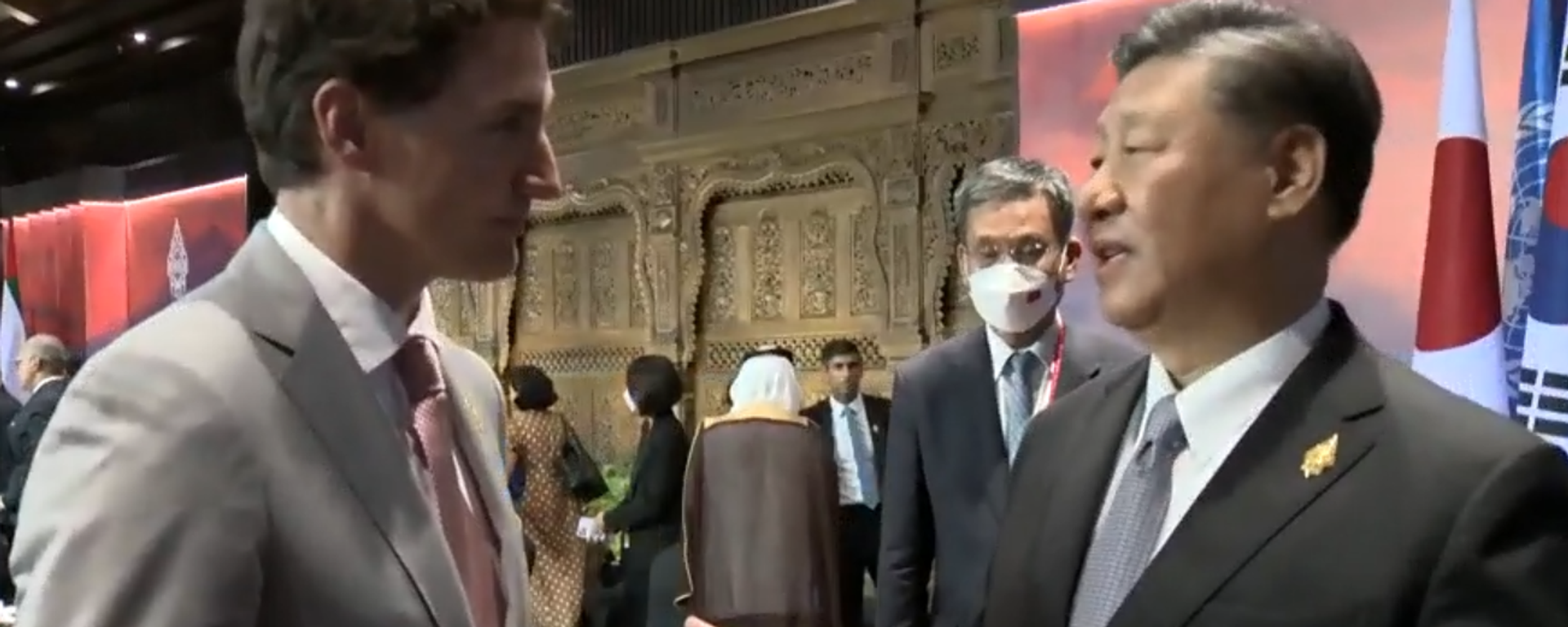
Statements about "challenging" Beijing fall in line with the recent spiral of diplomatic tensions between Canada and China. Most recently, China's leader Xi Jinping reprimanded Canada's Prime Minister Justin Trudeau on November 16 at the G20 Summit for disclosing the details of their private face-to-face talks.
“Everything we discussed is leaked to the papers. That’s not appropriate,” Xi told Trudeau through an interpreter, in a reference to reports that Trudeau had raised “serious concerns” about alleged Chinese meddling in Canada’s elections in their talks this week.
Beijing also expressed a protest and made a solemn representation to Ottawa over its involvement in the G7 foreign ministers' statement in August
on Taiwan, which China maintains is a renegade province
. The G7 foreign ministers issued a joint remark urging China to refrain from any unilateral changes of the status quo in the Taiwan Strait through force and expressing concern over Beijing's "threatening" live-fire exercises out of concern that they may trigger escalation.
Still earlier, in May, Ottawa banned the use of
5G gear from Huawei, citing alleged national security concerns. More subsequently, Canada ordered three Chinese companies
to divest from critical minerals in Canada.