https://sputnikglobe.com/20231028/monster-duo-of-black-holes-closest-to-earth-result-of-galactic-collision-study-shows-1114546997.html
Monster Duo of Black Holes Closest to Earth Result of Galactic Collision, Study Shows
Monster Duo of Black Holes Closest to Earth Result of Galactic Collision, Study Shows
Sputnik International
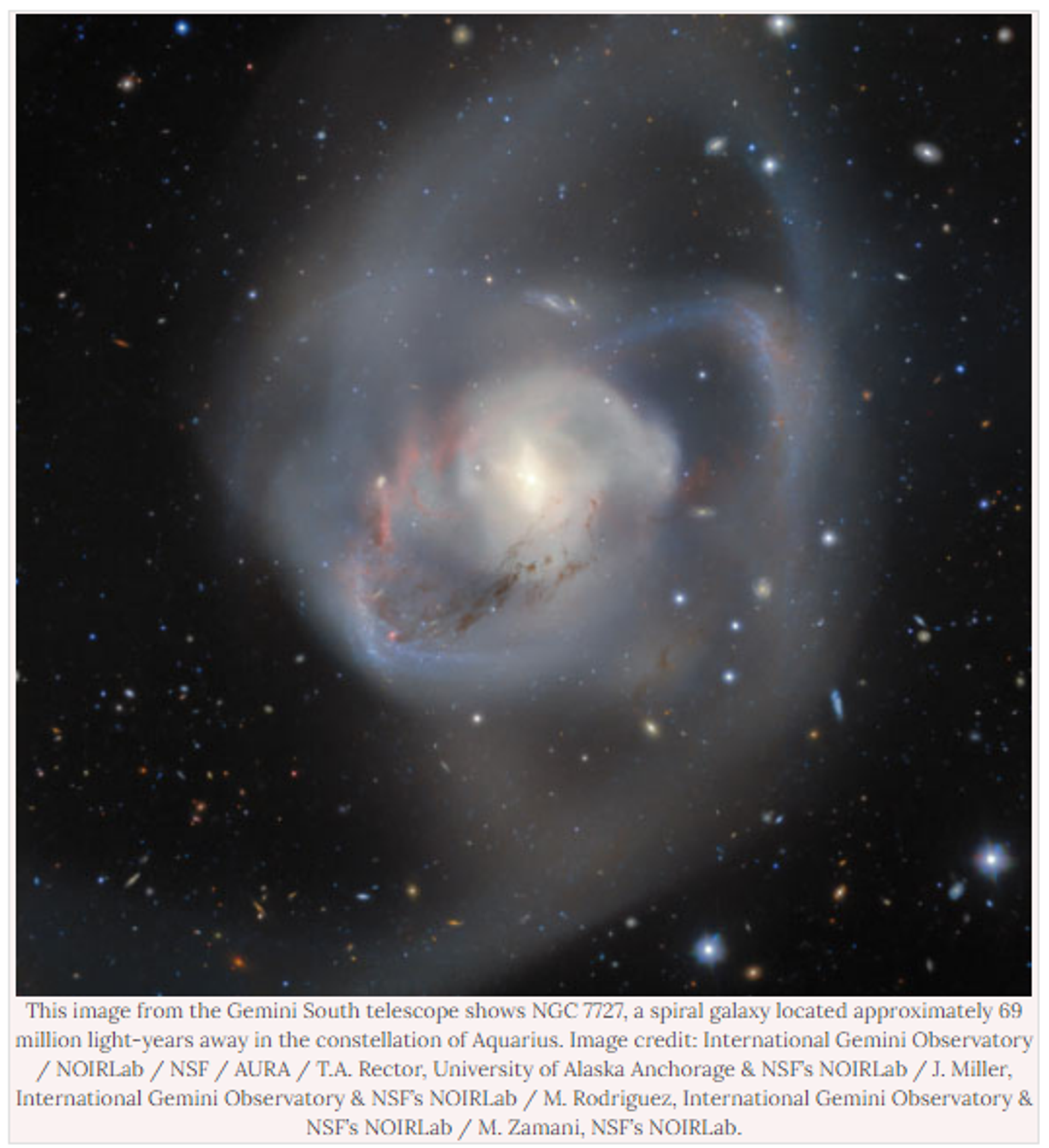
A pair of supermassive black holes close to our planet Earth were formed after a collision of two galaxies approximately a billion years ago, assert scientists, as they released an image using the Gemini South telescope.
2023-10-28T15:40+0000
2023-10-28T15:40+0000
2023-10-28T15:40+0000
beyond politics
science & tech
supermassive black hole
galaxy
milky way
andromeda galaxy
earth
https://cdn.imgsputnikglobe.com/images/sharing/article/eng/1114546997.jpg?1698507601
Two supermassive black holes close to our planet Earth were formed after a dramatic collision of two galaxies approximately a billion years ago, scientists assert, as they have released exciting new images of the pair.The black hole binary at a distance of some 90 million light-years away from Earth was discovered by a team of astronomers. They had been scrutinizing the galaxy merger designated as NGC 7727 using the Gemini South telescope perched on Cerro Pachón mountain in the Chilean Andes.It should be noted that there is a specific reason why NGC 7727 (also known as LEDA 72060) attracts the attention of astronomers. They believe that the spiral galaxy has the potential of shedding light on the fallout from the collision of our home galaxy, the Milky Way, with the neighboring spiral galaxy Andromeda . This is on track to happen sometime in around 4.5 billion years. Furthermore, scientists are thrilled because this pair of supermassive black holes is the closest to our planet.The image of the spiral galaxy was captured thanks to the Gemini Multi-Object Spectrograph (GMOS) on the Gemini South telescope. It shows swirling interstellar dust and gas "resembling freshly-spun cotton candy as they wrap around the merging cores of the progenitor galaxies,” as per a statement by NOIRLab astronomers.Alluding yet again to why studies of the NGC 7727 are important, the astronomers concluded:
https://sputnikglobe.com/20230915/closest-black-holes-are-likely-much-closer-than-we-think-astronomers-say-1113385907.html
andromeda galaxy
earth
Sputnik International
feedback@sputniknews.com
+74956456601
MIA „Rossiya Segodnya“
2023
News
en_EN
Sputnik International
feedback@sputniknews.com
+74956456601
MIA „Rossiya Segodnya“
Sputnik International
feedback@sputniknews.com
+74956456601
MIA „Rossiya Segodnya“
pair of supermassive black holes, two supermassive black holes closest to earth, collision of two galaxies, image using the gemini south telescope, potential collision of milky way with andromeda spiral galaxy
pair of supermassive black holes, two supermassive black holes closest to earth, collision of two galaxies, image using the gemini south telescope, potential collision of milky way with andromeda spiral galaxy
Monster Duo of Black Holes Closest to Earth Result of Galactic Collision, Study Shows
The giant spiral galaxy NGC 7727 in the constellation of Aquarius was discovered in 1785 by British astronomer William Herschel. It has long been in the crosshairs of astronomers, but its supermassive black hole duo – predicted to merge into one millions of years from now – has long dodged detection.
Two
supermassive black holes close to our planet Earth were formed after a dramatic collision of two galaxies approximately a billion years ago, scientists assert, as they have released exciting new images of the pair.
The black hole binary at a distance of some 90 million light-years away from Earth was discovered by a team of astronomers. They had been scrutinizing the galaxy merger designated as NGC 7727 using the Gemini South telescope perched on Cerro Pachón mountain in the Chilean Andes.
It should be noted that there is a specific reason why NGC 7727 (also known as LEDA 72060) attracts the attention of astronomers. They believe that the spiral galaxy has the potential of shedding light on the fallout from the collision of our home galaxy, the Milky Way, with the neighboring spiral galaxy Andromeda . This is on track to happen sometime in around 4.5 billion years. Furthermore, scientists are thrilled because this pair of supermassive black holes is the closest to our planet.
The image of the spiral galaxy was captured thanks to the Gemini Multi-Object Spectrograph (GMOS) on the Gemini South telescope. It shows swirling interstellar dust and gas "resembling freshly-spun cotton candy as they wrap around the merging cores of the progenitor galaxies,” as per a statement by NOIRLab astronomers.
“From the aftermath has emerged a scattered mix of active starburst regions and sedentary dust lanes encircling the system. It is estimated that the two will eventually merge into one in about 250 million years to form an even more massive black hole while dispersing violent ripples of gravitational waves across spacetime,” the team said.
Alluding yet again to why studies of the NGC 7727 are important, the astronomers concluded:
“Similar to Messier 87, an elliptical galaxy with a supermassive black hole at its heart, this may be the fate of the Milky Way and the Andromeda Galaxy when they fuse together in billions of years’ time.”
15 September 2023, 03:48 GMT